
Showing posts with label Airto Moreira. Show all posts

:::Weather Report:::

Posted: Wednesday, 14 September 2011 by jazzlover in Etykiety: , , , , ,
4

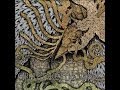
With two WR members emanating from Miles' Bitches Brew line-up (Zawinul and Shorter), it was obvious that their first album would be heavily influenced by it. But to everyone's surprise, WR's debut only took BB as a starting point and expanded on it, pushing the musical adventure a notch further and improvising so well and inspired, that you'd swear the whole thing is written. The duo enrolled the Czech-born Miroslav Vitous, (which will become an indispensable early WR's pillar) than secured Brazilian-born percussionist Airto Moreira and drummer Alphonse Mouzon, thus creating a real supergroup or an all-star line-up as the jazz circles prefer it. Released in 71 on the Columbia banner with a strange abstract artwork, WR's debut would take the JR scene by storm.
Right from the first twitches of Milky Way, we just know we're in for a long strange trip, as the music flirts with atonalities, then reaching a strange metamorphosed Miles jazz-funk (Umbrellas) that takes away the pleasantness and replacing it with cold hard improvising. On Seventh Arrow (a Vitous track), Zawinul's Fender Rhodes takes us sky-bound with Shorter's sax hovering like a mosquito around our ears until Zawinul derails the train into cosmic heights with his weird synths layers. The album's highlight is the Zawinul-penned Orange Lady, starting out lazily under the noontime sun, and then simply roasting under the scorching sun.
The flipside opens on the magical Morning Lake, with zawinul's Rhodes layering the track as to allow vitous to soar with his bass, while Shorter's sax is the cool breeze setting the mist apart to let the sunrays grace our ears. Waterfall, as you'd guess, is definitely more rapid than the Morning Lake, but obviously the cool Shorter breeze is not yet shaking the night's torpor. Shorter was being short-changed in terms of songwriting credits up to now, but he gets to close the album with two tracks, first the again-slow (but brooding and menacing) Tears (astounding track with celestial voices) and the funkier Eurydice, which is much closer to conventional jazz than the Z-S duo had done in quite a while.
An impeccable album, but not likely suited for everyone as it is much slower than you'd expect a WR album, especially for those more familiar with the Pastorius days. Personally, I always preferred the Vitous-era as they were truly groundbreaking and along with its successor, this album is clearly teir most progressive.
:::Review by Sean Trane:::

Weather Report - Weather Report (1971)

1. Milky Way (2:33)
2. Umbrellas (3:27)
3. Seventh Arrow (5:22)
4. Orange Lady (8:43)
5. Morning Lake (4:25)
6. Waterfall (6:20)
7. Tears (3:25)
8. Eurydice (5:45)

Credits
- Airto Moreira / percussion.
- Alphonze Mouzon / drums, voice
- Wayne Shorter / soprano & tenor saxophones
- Miroslav Vitous / acoustic & electric basses
- Joe Zawinul / acoustic & electric pianos

Additional musicians
- Don Alias / percussion
- Barbara Burton / percussion
:::Outback:::

Posted: Tuesday, 10 May 2011 by jazzlover in Etykiety: , , , ,
2

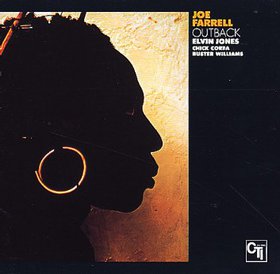
Outback is the second of his dates for the CTI label, all of which are compelling, and some, like this one, are brilliant. Recording in a quartet setting with Elvin Jones, Chick Corea, and Brazilian percussionist Airto Moreira, Farrell, with his reeds and woodwinds, pushes the envelope not only of his own previous conceptualism in jazz, but the CTI label's envelope as well. For starters, this is not a funk, soul, or fusion date, but an adventurous, spacy tightrope-walking exercise between open-ended composition and improvisation. That said, there is plenty of soul in the playing, not only by Farrell, but by all the players -- and Corea never sounded less academic or pointillistic than he does here.
There are four compositions on Outback, all of which were arranged by Farrell. The opener is the humid and mysterious title track by John Scott.
Staged in a series of minor-key signatures, Farrell primarily uses his winds here, flutes and piccolos, to weave a spellbinding series of ascending melodies over the extended voicings provided by Corea -- not exactly in counterpoint, but in spacious contrast. Jones is his typically uncanny self, skipping over cymbals and using a set of sticks more softly than any man can and still drive a band. Airto is positively hypnotic with his hand-drum fills, rubs and shimmers, going through the beat, climbing on top of it, and playing accents in tandem with Farrell in the solo sections. "Sound Down" is a bit more up-tempo and features Farrell fully engaged on the soprano. Buster Williams lays down a short staccato bassline that keeps Jones' bass drum pumping. As Farrell moves from theme/variation/melody to improvisation, he brings Corea, who, uncharacteristically, vamps off the melody before offering a series of ostinato replies before Farrell clearly surprises everybody with the knottiness of his legato phrasing. Corea's "Bleeding Orchid" is a ballad played with augmented modes and continually shifting intervals that can be heard and mapped best by Williams' adherence to the changes, though his pizzicato fills provide a sharp contrast to Farrell's trills and columnar arpeggiattic meditations that come off as a cross between pastoral jazz classicism and Middle Eastern folk music. Finally, on the leader's own "November 6th," the stops are pulled out in a Latin jazz workout that invokes Coltrane's version of "My Favorite Things," and Farrell digs deep into the tenor's middle register for a singing sound that brings to bear the Latin jazz howling of Gato Barbieri and the deep fire music of 'Trane, while being played through a gorgeously bluesy sophistication as the other players rally around and push through the tenor player's flights of near manic intensity. This is a stunner, an album that is at least as inspired as anything Farrell ever recorded, and perhaps more so.
:::Review by Thom Jurek:::

Joe Farrell - Outback (1971)

1. Outback (From The Motion Picture "Outback"), Composed By – J. Scott, 8:40
2. Sound Down, Composed By – G. Farrell, J. Farrell, 8:30
3. Bleeding Orchid, Composed By – C. Corea, 6:45
4. November 68th, Composed By – J. Farrell, 9:25

Credits
Bass – Buster Williams
Drums – Elvin Jones
Electric Piano – Chick Corea
Percussion – Airto Moreira
Saxophone [Soprano, Tenor], Flute, Flute [Alto, Piccolo] – Joe Farrell

:::Trumpet #3:::

Posted: Saturday, 23 October 2010 by jazzlover in Etykiety: , , , , , , , , , , ,
2

Donald Byrd's transitional sessions from 1969-1971 are actually some of the trumpeter's most intriguing work, balancing accessible, funky, Davis-style fusion with legitimate jazz improvisation. Electric Byrd, from 1970, is the best of the bunch, as Byrd absorbs the innovations of Bitches Brew and comes up with one of his most consistent fusion sets of any flavor. Byrd leads his largest fusion group yet (ten to 11 pieces), featuring many of his cohorts of the time (including Jerry Dodgion, Lew Tabackin, and Frank Foster on various woodwinds). Most important are electric pianist Duke Pearson, who once again dominates the arrangements, and percussionist Airto Moreira, who in places lends a strong Brazilian feel that predates Return to Forever. Moreira also contributes one of the four compositions, "Xibaba," which starts out as an airy Brazilian tune but morphs into a free-form effects extravaganza; the rest are Byrd originals that prove equally imaginative and diverse. The Brazilian-tinged opener "Estavanico" has a gentle, drifting quality that's often disrupted by jarring dissonances. There's also the shifting -- and sometimes even disappearing -- slow groove of "Essence," and the hard-edged, bop-based funk of "The Dude." Much of the album has a spacy, floating feel indebted to the psychedelic fusion of Bitches Brew; it's full of open-ended solo improvisations, loads of amplification effects, and striking sonic textures. The arrangements are continually surprising, and the band never works the same groove too long, switching or completely dropping the underlying rhythms. So even if it wears its influences on its sleeve, Electric Byrd is indisputably challenging, high-quality fusion. It's also the end of the line for jazz purists as far as Donald Byrd is concerned, which is perhaps part of the reason the album has yet to receive its proper due.
:::Review by Steve Huey:::

Donald Byrd - Electric Byrd (1970)

1. Estavanico 11:00
2. Essence 10:30
3. Xibaba 13:35
4. The Dude 8:00

Credits
Bass - Ron Carter
Drums - Mickey Roker
Electric Piano - Duke Pearson
Flute - Hermeto Pascoal (tracks: 1)
Guitar - Wally Richardson
Percussion - Airto Moreira
Saxophone [Alto, Soprano], Flute - Jerry Dodgion
Saxophone [Baritone], Clarinet - Pepper Adams
Saxophone [Tenor], Clarinet [Alto] - Frank Foster
Saxophone [Tenor], Flute - Lew Tabackin
Trombone - Bill Campbell
Trumpet - Donald Byrd

:::Bass #3:::

Posted: Tuesday, 19 October 2010 by jazzlover in Etykiety: , , , , ,
4

My rating of four stars is based on the assumption that the listener considers the confluence of jazz-rock fusion, disco and almost Zeuhl-like Magma-ish material, from a pioneer Miles Davis Alumni, of interest to a progarchives denizen. Admittedly, it's hard for me to imagine how this album might come across to a modern listener who didn't live through the disco age, the Miles late 70's electric period, and the Prog heyday of the mid-late 70's. The closest modern reference I can think of (minus the disco era vocals) is Squarepusher's "Music is Rotted One Note". I was notorious for toting the vinyl of this album with me circa 1977, and subjecting my friends to it. I found it's mix of booty shaking grooves, funky Weather Report and Miles-like textures, and spaced out background vocals to be a stand out of the era, and still enjoy listening to it today. If your taste in prog encompasses the jazz-rock and funk experiments of the mid 70's, Magma, or even the Japanese Zeuhl expressions of Koenjihyakkei and Bondage Fruit, I'd recommend giving this album a listen. Miroslav Vitous may not be a prog icon, but he certainly is a major figure in jazz and fusion history, and this particular entry should interest those with a broader interest and definition of what constitutes *prog*.
:::Review by G. Hogweed:::

Miroslav Vitous - Magical Shepherd (1976)

1. Basic Laws 11:46
2. New York City 9:32
3. Synthesizers Dance 5:09
4. Magical Shepherd 6:09
5. From Far Away 2:30
6. Aim Your Eye 6:57

Credits
Bass - Miroslav Vitous
Drums - Jack DeJohnette , James Gadson
Guitar - Miroslav Vitous
Keyboards - Herbie Hancock
Percussion - Airto Moreira
Vocals - Cheryl Grainger

:::Expectations:::

Posted: Friday, 4 September 2009 by jazzlover in Etykiety: , , , , ,
3


This was the first real indication to the world that Keith Jarrett was an ambitious, multi-talented threat to be reckoned with, an explosion of polystylistic music that sprawled over two LPs (now squeezed onto a single CD). Using his classic quartet (Dewey Redman, Charlie Haden, Paul Motian) as a base, Jarrett occasionally adds the biting rock-edged electric guitar of Sam Brown and always-intriguing percussionist Airto Moreira, and indulges in some pleasant string and brass arrangements of his own, along with some grinding organ smears and acceptable soprano sax. Jarrett again turns his early rampant eclecticism loose -- from earthy gospel-tinged soul-jazz to the freewheeling atonal avant-garde -- yet this time he does it with an exuberance and expansiveness that puts his previous solo work in the shade. "Common Mama," a spicy Latin workout with brass punctuations, "Take Me Back," driving soul jazz with streaks of electric jazz-rock, and the lengthy, nearly free "Nomads" are the most invigorating tracks.
:::Review by Richard S. Ginell:::

Keith Jarrett – Expectations (1971)

1. Common Mama (8:11)
2. The Magician In You (6:52)
3. Roussillion (5:22)
4. Expectations (4:26)
5. Take Me Back (9:30)
6. The Circular Letter (For J.K.) (5:04)
7. Nomads (17:21)
8. Sundance (4:27)
9. Bring Back The Time When (If) (9:51)
10. There Is A Road (God's River) (5:32)

Credits
Arranged By - Keith Jarrett
Bass - Charlie Haden
Composed By - Keith Jarrett
Drums - Paul Motian
Engineer - James Green , Tim Geelan
Guitar - Sam Brown
Mastered By [Remaster] - Mark Wilder
Other [Back Cover Photo] - Urve Kuusik
Other [Cover Art] - Robert Horvitz
Percussion - Airto Moreira
Piano - Keith Jarrett
Producer [Digital] - Nedra Neal
Producer [Original Recordings] - George Avakian
Saxophone [Soprano] - Keith Jarrett
Saxophone [Tenor] - Dewey Redman

:::Sky Dive:::

Posted: Wednesday, 18 March 2009 by jazzlover in Etykiety: , , , , , ,
2


Freddie Hubbard's fourth CTI recording (and the second one with Don Sebesky arrangements) certainly has a diverse repertoire. In addition to his originals "Povo" and "Sky Dive" (both of which are superior jam tunes), the trumpeter stretches out on the theme from The Godfather and Bix Beiderbecke's "In a Mist." The charts for the brass and woodwinds are colorful; there is a fine supporting cast that includes guitarist George Benson, Keith Jarrett on keyboards, and flutist Hubert Laws; and Hubbard takes several outstanding trumpet solos.
:::Review by Scott Yanow:::

Freddie Hubbard - Sky Dive (1972)

1. Povo (12:33)
2. In A Mist (7:04)
3. The Godfather (7:21)
4. Sky Dive (7:40)

Credits
Arranged By - Don Sebesky
Bass - Ron Carter
Clarinet - George Marge , Romeo Penque
Clarinet [Bass] - Phil Bodner
Conductor - Don Sebesky
Drums - Billy Cobham
Engineer - Rudy Van Gelder
Flugelhorn - Marvin Stamm
Flute - Hubert Laws
Flute [Alto] - Hubert Laws , Romeo Penque
Flute [Bass] - Hubert Laws
Guitar - George Benson
Oboe - Romeo Penque
Percussion - Airto , Ray Barretto
Piano - Keith Jarrett
Piano [Electric] - Keith Jarrett
Producer - Creed Taylor
Trombone - Garnett Brown , Wayne Andre
Trombone [Bass] - Paul Faulise
Trumpet - Alan Rubin , Freddie Hubbard
Tuba - Tony Price

:::Bitches Brew:::

Posted: Friday, 24 October 2008 by jazzlover in Etykiety: , , , , , , , , , ,
2

Bitches Brew is a studio double album by jazz musician Miles Davis, released in June of 1970 on Columbia Records. Recording sessions took place at Columbia's 30th Street Studio over the course of three days in August of 1969. The album continued Davis' experimentation of electric instruments previously featured on his critically acclaimed In a Silent Way album. With the use of these instruments, such as the electric piano and guitar, Davis rejected traditional jazz rhythms in favor of a looser, rock-influenced improvisational style.

Often cited as one of Davis' best-selling albums and masterpieces, Bitches Brew marked a turning point in modern jazz. Upon release, it received mixed criticism from fans and critics, alike, due to the album's unconventional style and revolutionary sound. Later on, Bitches Brew gained recognition as one of jazz's greatest albums and a progenitor of the jazz rock genre, as well as a major influence on rock and funk musicians.

In February 1969, Davis recorded In a Silent Way, a bold step into ambient funk and electric futurism that inspired the trumpeter to go further out at the sessions for Bitches Brew that August. Davis wanted, he said, "the best damn rock & roll band in the world," to connect jazz with the forward motion of Jimi Hendrix and Sly Stone. Davis' band was superbad (Joe Zawinul, John McLaughlin, Chick Corea, Wayne Shorter, etc.). But the word fusion was never big enough to describe the visceral thrill of these explosive studio explorations and the pioneering tape-edit wizardry of producer Teo Macero, arguably the original Chemical Brother.

No artist has ever reinvented themselves quite so much as Miles Davis. By 1969 he had already upended jazz by championing modal jazz (and in the process recording Kind of Blue which is almost universally acknowledged as the greatest jazz album of all time). By 1969 he was ready to upend it again, and his previous album In A Silent Way had already given hints of what was to come with its increasing shift from an acoustic to an electric sound.

Recording sessions:

As was Davis's practice, he called musicians to the recording studio on very short notice. A few pieces on Bitches Brew were rehearsed before the recording sessions, but other times the musicians had little or no idea what they were to record. Once in the recording studio, the players were typically given only a few instructions: a tempo count, a few chords or a hint of melody, and suggestions as to mood or tone. Davis liked to work this way; he thought it forced musicians to pay close attention to one another, to their own performances, or to Davis's cues, which could change at any moment. On the quieter moments of "Bitches Brew", for example, Davis's voice is audible, giving instructions to the musicians: snapping his fingers to indicate tempo, or, in his distinctive whisper, saying, "Keep it tight" or telling individuals when to solo.

Davis composed most of the music on the album. The two important exceptions were the complex "Pharaoh's Dance" (composed by Joe Zawinul) and the ballad "Sanctuary" (composed by Wayne Shorter). The latter had been recorded as a fairly straightforward ballad early in 1968, but was given a radically different interpretation on Bitches Brew. It begins with Davis and Chick Corea improvising on the standard "I Fall in Love too Easily" before Davis plays the "Sanctuary" theme. Then, not unlike Davis's recording of Shorter's "Nefertiti" two years earlier, the horns repeat the melody over and over while the rhythm section builds up the intensity. The issued "Sanctuary" is actually two consecutive takes of the piece.

Despite his reputation as a "cool", melodic improviser, much of Davis's playing on this album is aggressive and explosive, often playing fast runs and venturing into the upper register of the trumpet. His closing solo on "Miles Runs the Voodoo Down" is particularly noteworthy in this regard. Davis did not perform on the short piece "John McLaughlin".

I can't really explain what Bitches Brew is all about without a bit of historical context. This was 1969 when experimentation in music was at its height. In Britain Pink Floyd were popularising psychedelia and King Crimson were about to release In The Court of the Crimson King and invent progressive rock. In America Davis, ever the restless genius and unable to stand still musically was looking for something more radical and dramatic still. Supplementing his band up to no less than 3 keyboard players and a bass clarinet, and surrounding himself as ever with musicians of the highest caliber he went into the studio for 3 days to record a double album of 6 densely layered tracks.

So what came out? Well, easy listening this ain't and I certainly wouldn't recommend this as an introduction to Jazz or to Miles Davis (Kind of Blue does very nicely for both of those - you might as well start with the best!). The first disc consists of 2 side length tracks, "Pharoah's Dance" and "Bitches Brew", both over 20 minutes. They're both wild cocktails of smoky improvisational jazz. Pharoah's Dance is famous for having no less than 19 edits within it, some as short as 1 second long, and really marks the start of using the studio and the editing booth as an instrument in its own right. I actually can't describe either of these tracks well as each time you listen to them they sound different: there's little structure to hang on to and a mellow groove can quickly dissolve into shards of dissonance with Davis's distinctive trumpet shrieking over the top.

The second disc of the album is somewhat more relaxed. "Spanish Key" actually stays on the same groove for nearly 17 minutes (but certainly isn't boring for it). This is followed by "John McLaughlin" (yep, the track is named after the famous jazz guitarist) and "Miles Runs the Voodoo Down", a menacing track that can almost sound like Led Zeppelin in parts. Finally comes "Sanctuary", a soft sad and superb close with Davis's trumpet at its most plaintive.

The effects of Bitches Brew were revolutionary. Davis had merged rock and jazz, inventing what we now call fusion (perhaps I should say remerged - after all Rock is a 50's ofshoot of Jazz). Extraordinarily for such an experimental album it was one of Davis's biggest sellers and also won him a Grammy. It's influence still permeates todays music. Thom Yorke from Radiohead admits that previous to recording their masterwork OK Computer, Bitches Brew had been lodged almost permanently in his CD player. After its release in 1970, jazz, rock, and the whole of music would never be the same.

:::From http://www.milesdavis.com/:::

Miles Davis - Bitches Brew (1970)

CD 1
1 - Pharaoh's Dance (19:57)
2 - Bitches Brew (26:59)

CD 2
1 - Spanish Key (17:26)
2 - John Mclaughlin (4:43)
3 - Miles Runs The Voodoo Down (14:02)
4 - Sanctuary (10:53)
5 - Feio (11:49)

Credits
* Miles Davis - trumpet
* Wayne Shorter - soprano saxophone
* Bennie Maupin - bass clarinet
* Chick Corea - electric piano (solo on "Miles Runs The Voodoo Down")
* John McLaughlin - guitar
* Dave Holland - bass
* Harvey Brooks - electric bass
* Lenny White - drum set
* Jack DeJohnette - drum set
* Billy Cobham - drum set
* Don Alias - congas, drum set
* Airto Moreira - percussion
* Juma Santos (credited as "Jim Riley") - shaker, congas
* Larry Young - electric piano on "Miles Runs the Voodoo Down" "John McLaughlin" "Spanish Key" and "Pharaoh's Dance"
* Joe Zawinul - electric piano on "Bitches Brew" "Sanctuary" "Spanish Key" and "Pharaoh's Dance"