Showing posts with label Chick Corea. Show all posts

:::Outback:::

Posted: Tuesday, 10 May 2011 by jazzlover in Etykiety: , , , ,
2

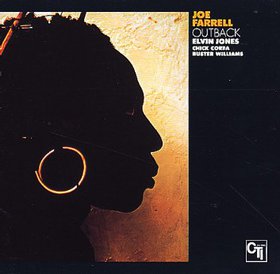
Outback is the second of his dates for the CTI label, all of which are compelling, and some, like this one, are brilliant. Recording in a quartet setting with Elvin Jones, Chick Corea, and Brazilian percussionist Airto Moreira, Farrell, with his reeds and woodwinds, pushes the envelope not only of his own previous conceptualism in jazz, but the CTI label's envelope as well. For starters, this is not a funk, soul, or fusion date, but an adventurous, spacy tightrope-walking exercise between open-ended composition and improvisation. That said, there is plenty of soul in the playing, not only by Farrell, but by all the players -- and Corea never sounded less academic or pointillistic than he does here.
There are four compositions on Outback, all of which were arranged by Farrell. The opener is the humid and mysterious title track by John Scott.
Staged in a series of minor-key signatures, Farrell primarily uses his winds here, flutes and piccolos, to weave a spellbinding series of ascending melodies over the extended voicings provided by Corea -- not exactly in counterpoint, but in spacious contrast. Jones is his typically uncanny self, skipping over cymbals and using a set of sticks more softly than any man can and still drive a band. Airto is positively hypnotic with his hand-drum fills, rubs and shimmers, going through the beat, climbing on top of it, and playing accents in tandem with Farrell in the solo sections. "Sound Down" is a bit more up-tempo and features Farrell fully engaged on the soprano. Buster Williams lays down a short staccato bassline that keeps Jones' bass drum pumping. As Farrell moves from theme/variation/melody to improvisation, he brings Corea, who, uncharacteristically, vamps off the melody before offering a series of ostinato replies before Farrell clearly surprises everybody with the knottiness of his legato phrasing. Corea's "Bleeding Orchid" is a ballad played with augmented modes and continually shifting intervals that can be heard and mapped best by Williams' adherence to the changes, though his pizzicato fills provide a sharp contrast to Farrell's trills and columnar arpeggiattic meditations that come off as a cross between pastoral jazz classicism and Middle Eastern folk music. Finally, on the leader's own "November 6th," the stops are pulled out in a Latin jazz workout that invokes Coltrane's version of "My Favorite Things," and Farrell digs deep into the tenor's middle register for a singing sound that brings to bear the Latin jazz howling of Gato Barbieri and the deep fire music of 'Trane, while being played through a gorgeously bluesy sophistication as the other players rally around and push through the tenor player's flights of near manic intensity. This is a stunner, an album that is at least as inspired as anything Farrell ever recorded, and perhaps more so.
:::Review by Thom Jurek:::

Joe Farrell - Outback (1971)

1. Outback (From The Motion Picture "Outback"), Composed By – J. Scott, 8:40
2. Sound Down, Composed By – G. Farrell, J. Farrell, 8:30
3. Bleeding Orchid, Composed By – C. Corea, 6:45
4. November 68th, Composed By – J. Farrell, 9:25

Credits
Bass – Buster Williams
Drums – Elvin Jones
Electric Piano – Chick Corea
Percussion – Airto Moreira
Saxophone [Soprano, Tenor], Flute, Flute [Alto, Piccolo] – Joe Farrell

:::Piano #4:::

Posted: Tuesday, 28 December 2010 by jazzlover in Etykiety: , , ,
2

This encounter between Chick Corea (sticking to acoustic piano), tenor saxophonist Michael Brecker, bassist Eddie Gomez, and drummer Steve Gadd lives up to expectations. The original program featured three lengthy "Quartet" pieces including sections dedicated to Duke Ellington and John Coltrane. The CD reissue adds four briefer pieces that were previously unissued, including an unaccompanied Brecker workout on "Confirmation" that would be perfect for "blindfold" tests. This blowing date is highly recommended for all true jazz fans.
:::Review by Scott Yanow:::

Chick Corea - Three Quartets (1981)

1. Quartet No. 1 10:09
2. Quartet No. 3 9:36
3. Quartet No. 2 Part 1 (Dedicated To Duke Ellington) 7:05
4. Quartet No. 2 Part 2 (Dedicated To John Coltrane) 11:48

Credits
Bass - Eddie Gomez
Drums - Steve Gadd
Piano - Chick Corea
Saxophone - Michael Brecker

:::Spaces:::

Posted: Thursday, 5 February 2009 by jazzlover in Etykiety: , , , ,
4


In 1969 it seemed that New York City was the center of the universe as far as the world of jazz was concerned. At this focal point was a manifestation of daring musicians who were on the threshhold of redefining jazz with Miles Davis as their chief architect. His " Bitches Brew " sessions spawned many revolutionary ideas towards jazz, most notably new philosophies towards improvised music and the use of volume. Around the same time a young sparkplug named Larry Coryell who had played guitar on innovative recordings by Herbie Mann, Gary Burton and others was creating his own adventurous music releasing three hybrid albums which seeked to fuse jazz and rock attitudes into one creature. His fourth endeavour, "Spaces" was about to transcend jazz as it was known at the time and plant a seed for what was to come.
Coryell had no problems attracting interest for this new project and recruited four exceptional musicians who all, at on time or another, had played with maestro Miles. Guitarist John McLaughlin was a perfect sparring partner. McLaughlin, who had just arrived from Europe, was playing with the newly formed jazz-rock outfit Tony Williams`Lifetime and had also played on the " Bitches Brew " sessions and, like Coryell, he had jammed with Hendrix and shared Coryell`s interest in certain aspects of rock music. Drummer Billy Cobham had already made his mark and in addition to playing briefly with Miles he had apprenticed in US Army bands and played on recordings by Horace Silver and George Benson. Bassist Miroslav Vitious had played with Miles while keyboardist Chick Corea had just joined Miles`band.
While "Spaces" has been frequently referred to as the purveyer of `70 fusion ( and this may be true to a point ) it is more of a jazz record than anything. It didn`t sound like any jazz record up to that point but has probably been referred to as the forerunner of fusion because the individual musicians went on to form or become part of the heavyweight fusion groups of the `70s, The Mahavishnu Orchestra, Weather Report, Return To Forever and Coryell`s own fusion group The Eleventh House. Nonetheless, unquestionably " Spaces " was certainly the embryo from which fusion blossomed.
The album, in it`s short 36 minutes and 42 seconds covers many points on the jazz spectrum. An ominous bowed bass passage from Vitous introduces the title track, " Spaces ( infinite ) " which develops into an atonal guitar exchange between Coryell and McLaughlin and certainly the high point of the work. Subtle psychedelic undertones can be heard but there`s no overkill and it is by far the " rockiest " piece on the album with some use of distortion. " Rene`s Theme" while exluding the rythmn section is more than adequately compensated for with the frenzied bop-like rythmn patterns on behalf of both guitarists on this acoustic track which blends elements of Coltrane and Django who were big influences on both guitarists. To those unfamiliar with the guitarists` playing at the time ( and both had found their distinctive voices by 1969 ) it might be hard to discern who is playing what but not to worry the liner notes solve this problem. In General, Coryell does most of the soloing ( hey he`s allowed, it`s his record OK ) while McLaughlin provides well timed rythmn inserts. An example of Coryell`s insane soloing can be found on " Wrong Is Right" where he let`s loose with a lightning speed silent barrage which would defy any guitar player`s immagination. Two of the more pensive pieces on the album also feature some interesting experimentations. " Gloria`s Step " is introduced by another bowed bass passage from vitous and at first on might think it`s a cello playing. " Chris ", which is obviously a Bill Evans inspired piece, features Chick Corea on electric piano. His playing here is both poetic and enticing and imerses the listener into an almost surealistic pleasurable dream which complement Coryell`s rising and falling guitar ideas. A mention also should be made of Cobham who pulses his way along with the group and fits in so perfectly sometimes you forget he`s there because of some of the grooves he gets into.
Nothing really peaks on " Spaces " and while lacking the razzle dazzle of the fusion bands it inspired, it relies on raw in-your-face sincere playing on behalf of all the musicians with only minimilistic use of volume & distortion. No studio tricks or wah wah pedals here folks. If you`re expecting an amps turned to eleven last man standing guitar battle royale then you`l have to look to other avenues. What you get here is two young virtuoso guitarists interacting beautifully who obviously have respect for each other`s respective talents. By a long shot one of the more challenging jazz albums ever recorded and even if it runs a mere 36 minutes+ it seems like an eternity. Perhaps not the best starting point for one wishing to explore the musical mind of Larry Coryell but if you`re looking for something adventurous you`ve come to the right place with " Spaces". Fusion before fusion. Precious. 5 stars what else.
:::Review by Ian Gledhill:::

Larry Coryell – Spaces (1969)

1. Spaces ( Infinite ) ( 9:16 )
2. Rene`s Theme ( 4:06 )
3. Gloria`s Step ( 4:29 )
4. Wrong Is Right ( 9:00 )
5. Chris ( 9:31 )
6. New Year`s Day In LA, 1968 ( 0:20 )

Credits
Larry Coryell / guitars
John McLaughlin / guitars
Chick Corea / electric piano
Miroslav Vitous / double bass
Billy Cobham / drums

:::Bitches Brew:::

Posted: Friday, 24 October 2008 by jazzlover in Etykiety: , , , , , , , , , ,
2

Bitches Brew is a studio double album by jazz musician Miles Davis, released in June of 1970 on Columbia Records. Recording sessions took place at Columbia's 30th Street Studio over the course of three days in August of 1969. The album continued Davis' experimentation of electric instruments previously featured on his critically acclaimed In a Silent Way album. With the use of these instruments, such as the electric piano and guitar, Davis rejected traditional jazz rhythms in favor of a looser, rock-influenced improvisational style.

Often cited as one of Davis' best-selling albums and masterpieces, Bitches Brew marked a turning point in modern jazz. Upon release, it received mixed criticism from fans and critics, alike, due to the album's unconventional style and revolutionary sound. Later on, Bitches Brew gained recognition as one of jazz's greatest albums and a progenitor of the jazz rock genre, as well as a major influence on rock and funk musicians.

In February 1969, Davis recorded In a Silent Way, a bold step into ambient funk and electric futurism that inspired the trumpeter to go further out at the sessions for Bitches Brew that August. Davis wanted, he said, "the best damn rock & roll band in the world," to connect jazz with the forward motion of Jimi Hendrix and Sly Stone. Davis' band was superbad (Joe Zawinul, John McLaughlin, Chick Corea, Wayne Shorter, etc.). But the word fusion was never big enough to describe the visceral thrill of these explosive studio explorations and the pioneering tape-edit wizardry of producer Teo Macero, arguably the original Chemical Brother.

No artist has ever reinvented themselves quite so much as Miles Davis. By 1969 he had already upended jazz by championing modal jazz (and in the process recording Kind of Blue which is almost universally acknowledged as the greatest jazz album of all time). By 1969 he was ready to upend it again, and his previous album In A Silent Way had already given hints of what was to come with its increasing shift from an acoustic to an electric sound.

Recording sessions:

As was Davis's practice, he called musicians to the recording studio on very short notice. A few pieces on Bitches Brew were rehearsed before the recording sessions, but other times the musicians had little or no idea what they were to record. Once in the recording studio, the players were typically given only a few instructions: a tempo count, a few chords or a hint of melody, and suggestions as to mood or tone. Davis liked to work this way; he thought it forced musicians to pay close attention to one another, to their own performances, or to Davis's cues, which could change at any moment. On the quieter moments of "Bitches Brew", for example, Davis's voice is audible, giving instructions to the musicians: snapping his fingers to indicate tempo, or, in his distinctive whisper, saying, "Keep it tight" or telling individuals when to solo.

Davis composed most of the music on the album. The two important exceptions were the complex "Pharaoh's Dance" (composed by Joe Zawinul) and the ballad "Sanctuary" (composed by Wayne Shorter). The latter had been recorded as a fairly straightforward ballad early in 1968, but was given a radically different interpretation on Bitches Brew. It begins with Davis and Chick Corea improvising on the standard "I Fall in Love too Easily" before Davis plays the "Sanctuary" theme. Then, not unlike Davis's recording of Shorter's "Nefertiti" two years earlier, the horns repeat the melody over and over while the rhythm section builds up the intensity. The issued "Sanctuary" is actually two consecutive takes of the piece.

Despite his reputation as a "cool", melodic improviser, much of Davis's playing on this album is aggressive and explosive, often playing fast runs and venturing into the upper register of the trumpet. His closing solo on "Miles Runs the Voodoo Down" is particularly noteworthy in this regard. Davis did not perform on the short piece "John McLaughlin".

I can't really explain what Bitches Brew is all about without a bit of historical context. This was 1969 when experimentation in music was at its height. In Britain Pink Floyd were popularising psychedelia and King Crimson were about to release In The Court of the Crimson King and invent progressive rock. In America Davis, ever the restless genius and unable to stand still musically was looking for something more radical and dramatic still. Supplementing his band up to no less than 3 keyboard players and a bass clarinet, and surrounding himself as ever with musicians of the highest caliber he went into the studio for 3 days to record a double album of 6 densely layered tracks.

So what came out? Well, easy listening this ain't and I certainly wouldn't recommend this as an introduction to Jazz or to Miles Davis (Kind of Blue does very nicely for both of those - you might as well start with the best!). The first disc consists of 2 side length tracks, "Pharoah's Dance" and "Bitches Brew", both over 20 minutes. They're both wild cocktails of smoky improvisational jazz. Pharoah's Dance is famous for having no less than 19 edits within it, some as short as 1 second long, and really marks the start of using the studio and the editing booth as an instrument in its own right. I actually can't describe either of these tracks well as each time you listen to them they sound different: there's little structure to hang on to and a mellow groove can quickly dissolve into shards of dissonance with Davis's distinctive trumpet shrieking over the top.

The second disc of the album is somewhat more relaxed. "Spanish Key" actually stays on the same groove for nearly 17 minutes (but certainly isn't boring for it). This is followed by "John McLaughlin" (yep, the track is named after the famous jazz guitarist) and "Miles Runs the Voodoo Down", a menacing track that can almost sound like Led Zeppelin in parts. Finally comes "Sanctuary", a soft sad and superb close with Davis's trumpet at its most plaintive.

The effects of Bitches Brew were revolutionary. Davis had merged rock and jazz, inventing what we now call fusion (perhaps I should say remerged - after all Rock is a 50's ofshoot of Jazz). Extraordinarily for such an experimental album it was one of Davis's biggest sellers and also won him a Grammy. It's influence still permeates todays music. Thom Yorke from Radiohead admits that previous to recording their masterwork OK Computer, Bitches Brew had been lodged almost permanently in his CD player. After its release in 1970, jazz, rock, and the whole of music would never be the same.

:::From http://www.milesdavis.com/:::

Miles Davis - Bitches Brew (1970)

CD 1
1 - Pharaoh's Dance (19:57)
2 - Bitches Brew (26:59)

CD 2
1 - Spanish Key (17:26)
2 - John Mclaughlin (4:43)
3 - Miles Runs The Voodoo Down (14:02)
4 - Sanctuary (10:53)
5 - Feio (11:49)

Credits
* Miles Davis - trumpet
* Wayne Shorter - soprano saxophone
* Bennie Maupin - bass clarinet
* Chick Corea - electric piano (solo on "Miles Runs The Voodoo Down")
* John McLaughlin - guitar
* Dave Holland - bass
* Harvey Brooks - electric bass
* Lenny White - drum set
* Jack DeJohnette - drum set
* Billy Cobham - drum set
* Don Alias - congas, drum set
* Airto Moreira - percussion
* Juma Santos (credited as "Jim Riley") - shaker, congas
* Larry Young - electric piano on "Miles Runs the Voodoo Down" "John McLaughlin" "Spanish Key" and "Pharaoh's Dance"
* Joe Zawinul - electric piano on "Bitches Brew" "Sanctuary" "Spanish Key" and "Pharaoh's Dance"

:::My Spanish Heart:::

Posted: Wednesday, 10 September 2008 by jazzlover in Etykiety: ,
1

This 1976 release features Chick Corea in what was then, and remains, a unique musical setting. While it is truly an electric jazz fusion record, it is also the only solo recording of Corea's on which he attempted to truly explore the Latin side of his musical heritage. My Spanish Heart marks a full-scale, yet thoroughly modern, exploration in the musical lineage Corea sprang from. Making full use of synthesizer technology, a string section, and synth-linked choruses -- of two voices, his own and that of Gayle Moran -- as well as percussionist Don Alias, drummer Steve Gadd, a full brass section, and the sparse use of Jean Luc Ponty ("Armando's Rumba") and bassist Stanley Clark, Corea largely succeeded in creating a Spanish/Latin tapestry of sounds, textures, impressions, and even two suites -- "Spanish Fantasy" and "El Boro." The string quartet performs its intricate and gorgeously elegant arrangements with verve and grace on "Day Danse" and on the suites, with Corea's contrapuntal pianism creating a sharp yet warm contrast to the shifting tempos, wild interval leaps, and shimmering timbral balances that occur. The only pieces that sound dated on this double-album-length set are the fusion pieces, which are, with their production and knotty stop-and-start modulations and key signature equations -- omplete with aggressive arpeggios and scalar linguistics -- destined to be limited in expression by the voice of their use of technology. Thus, "Love Castles," "The Gardens," and "Night Streets" suffer from their rather cheesy production despite their tastefully done double fusion semantics (jazz to rock to Latin music). There is no doubt that Corea's musicianship was up to any task he chose at this point in time. Simply put, he was compositionally and intellectually at the top of his game, and this record, despite the many of his that haven't aged well, still surprises despite its production shortcomings.

:::By Thom Jurek:::

Chick Corea – My Spanish Heart (1976)

1. Love Castle (4:47)
2. The Gardens (3:11)
3. Day Danse (4:29)
4. My Spanish Heart (1:37)
5. Night Streets (6:02)
6. The Hilltop (6:15) Composed By - Stanley Clarke
7. Wind Danse (4:55)
8. Armando's Rhumba (5:19) Handclaps - Narada Michael Walden Violin - Jean-Luc Ponty
9. Prelude To El Bozo (1:36)
10. El Bozo, Part I (2:49)
11. El Bozo, Part II (2:06)
12. El Bozo, Part III (4:56)
13. Spanish Fantasy, Part I (6:07)
14. Spanish Fantasy, Part II (5:11)
15. Spanish Fantasy, Part III (3:09)
16. Spanish Fantasy, Part IV (5:04)

Credits
Arranged By, Piano [Acoustic, Fender], Synthesizer [Moog 15, Mini-moog, Arp Odessy, Polymoog], Organ [Yamaha], Handclaps - Chick Corea
Bass [Acoustic] - Stanley Clarke
Composed By - Chick Corea (tracks: 1 to 5, 7 to 19)
Drums - Steve Gadd
Engineer - Bernie Kirsh
Percussion - Don Alias
Producer - Chick Corea
Strings - Arriaga Quartet
Trombone - Ron Moss
Trumpet - John Rosenberg , Stuart Blumberg
Trumpet [Lead] - John Thomas (3)
Vocals, Choir - Gayle Moran

:::Sweet Rain:::

Posted: Thursday, 7 August 2008 by jazzlover in Etykiety: , ,
2

One of Stan Getz's all-time greatest albums, Sweet Rain was his first major artistic coup after he closed the book on his bossa nova period, featuring an adventurous young group that pushed him to new heights in his solo statements. Pianist Chick Corea, bassist Ron Carter, and drummer Grady Tate were all schooled in '60s concepts of rhythm-section freedom, and their continually stimulating interplay helps open things up for Getz to embark on some long, soulful explorations (four of the five tracks are over seven minutes). The neat trick of Sweet Rain is that the advanced rhythm section work remains balanced with Getz's customary loveliness and lyricism. Indeed, Getz plays with a searching, aching passion throughout the date, which undoubtedly helped Mike Gibbs' title track become a standard after Getz's tender treatment here. Technical perfectionists will hear a few squeaks on the LP's second half (Getz's drug problems were reputedly affecting his articulation somewhat), but Getz was such a master of mood, tone, and pacing that his ideas and emotions are communicated far too clearly to nit-pick. Corea's spare, understated work leaves plenty of room for Getz's lines and the busily shifting rhythms of the bass and drums, heard to best effect in Corea's challenging opener "Litha." Aside from that and the title track, the repertoire features another Corea original ("Windows"), the typically lovely Jobim tune "O Grande Amor," and Dizzy Gillespie's Latin-flavored "Con Alma." The quartet's level of musicianship remains high on every selection, and the marvelously consistent atmosphere the album evokes places it among Getz's very best. A surefire classic.

:::By Steve Huey:::

Stan Getz - Sweet Rain (1967)

1. Litha (9:00)
2. O Grande Amor (4:43)
3. Sweet Rain (7:08)
4. Con Alma (8:00)
5. Windows (8:52)

Credits
Bass - Ron Carter
Drums - Grady Tate
Engineer - Rudy Van Gelder
Piano - Chick Corea
Producer - Creed Taylor
Saxophone [Tenor] - Stan Getz

Notes
Recorded March 30, 1967 at Rudy Van Gelder Studio, Engelwood Cliffs, New Jersey.

:::Hymn of the Seventh Galaxy:::

Posted: Sunday, 16 March 2008 by jazzlover in Etykiety: , , , ,
3

The second incarnation of Chick Corea's influential fusion group released only a single record, the magnificent Hymn of the Seventh Galaxy. Featuring a more rock-oriented approach than the Flora Purim-Joe Farrell band that was responsible for both Return to Forever and Light as a Feather, Corea and old standby Stanley Clarke join forces here with propulsive drummer Lenny White and electric guitarist Bill Connors. Although Connors lacks the sophistication of Al Di Meola, the young guitarist who replaced him, he possesses a deliciously raw sound that keeps Corea's heady compositions firmly grounded. White introduces a funk aspect to the music, replacing Airto's Latin grooves from the first two records. Clarke is as good, wrenching some truly frightening sounds out of his electric basses. This increased emphasis on electric instrumentation, also displayed in Corea's heavy use of synthesizers, is another thing that separates this record from the previous Return to Forever releases. And as good as the band performances are, it is the quality of the compositions that marks Hymn of the Seventh Galaxy as an indispensable disc of '70s fusion. "Captain Senor Mouse," one of Corea's finest fusion compositions, receives an excellent treatment here. Likewise, the two-part "Space Circus" is a fantastic mix of haunting and grooving elements, with some simply incredible solos thrown into the mix. With Hymn of the Seventh Galaxy, Corea continues his streak of simply timeless fusion albums. The best of the electric RTF albums.
:::By Daniel Gioffre:::

Return to Forever - Hymn of the Seventh Galaxy (1973)

1. Hymn of the Seventh Galaxy 3:28
2. After the Cosmic Rain 8:23
3. Captain Señor Mouse 8:58
4. Theme to the Mothership 8:47
5. Space Circus
Part I 1:30
Part II 4:44
6. The Game Maker 6:47

Credits
Acoustic Guitar, Guitar - Bill Connors
Bass, Bells - Stanley Clarke
Drums, Percussion, Congas, Bongos - Lenny White
Engineer - Shelly Yakus
Piano, Organ, Harpsichord, Gong - Chick Corea

:::In a Silent Way:::

Posted: Sunday, 2 March 2008 by jazzlover in Etykiety: , , , , , , ,
2

Listening to Miles Davis' originally released version of In a Silent Way in light of the complete sessions released by Sony in 2001 (Columbia Legacy 65362) reveals just how strategic and dramatic a studio construction it was. If one listens to Joe Zawinul's original version of "In a Silent Way," it comes across as almost a folk song with a very pronounced melody. The version Miles Davis and Teo Macero assembled from the recording session in July of 1968 is anything but. There is no melody, not even a melodic frame. There are only vamps and solos, grooves layered on top of other grooves spiraling toward space but ending in silence. But even these don't begin until almost ten minutes into the piece. It's Miles and McLaughlin, sparely breathing and wending their way through a series of seemingly disconnected phrases until the groove monster kicks in. The solos are extended, digging deep into the heart of the ethereal groove, which was dark, smoky, and ashen. McLaughlin and Hancock are particularly brilliant, but Corea's solo on the Fender Rhodes is one of his most articulate and spiraling on the instrument ever. The A-side of the album, "Shhh/Peaceful," is even more so. With Tony Williams shimmering away on the cymbals in double time, Miles comes out slippery and slowly, playing over the top of the vamp, playing ostinato and moving off into more mysterious territory a moment at a time. With Zawinul's organ in the background offering the occasional swell of darkness and dimension, Miles could continue indefinitely. But McLaughlin is hovering, easing in, moving up against the organ and the trills by Hancock and Corea; Wayne Shorter hesitantly winds in and out of the mix on his soprano, filling space until it's his turn to solo. But John McLaughlin, playing solos and fills throughout (the piece is like one long dreamy solo for the guitarist), is what gives it its open quality, like a piece of music with no borders as he turns in and through the commingling keyboards as Holland paces everything along. When the first round of solos ends, Zawinul and McLaughlin and Williams usher it back in with painterly decoration and illumination from Corea and Hancock. Miles picks up on another riff created by Corea and slips in to bring back the ostinato "theme" of the work. He plays glissando right near the very end, which is the only place where the band swells and the tune moves above a whisper before Zawinul's organ fades it into silence. This disc holds up, and perhaps is even stronger because of the issue of the complete sessions. It is, along with Jack Johnson and Bitches Brew, a signature Miles Davis session from the electric era.
:::By Thom Jurek:::

Miles Davis - In a Silent Way (1969)

1. Shhh / Peaceful (18:30)
Written-By - Miles Davis
2. In A Silent Way / It's About That Time (20:00)
Written-By - Joe Zawinul , Miles Davis

Credits
Bass - Dave Holland
Drums - Tony Williams
Electric Piano - Chick Corea , Herbie Hancock
Engineer - Russ Payne , Stan Tonkel
Guitar - John McLaughlin
Organ, Electric Piano - Josef Zawinul
Other [Back Cover Notes] - Frank Glenn
Photography [Cover Photograph] - Lee Friedlander
Producer - Teo Macero
Saxophone [Tenor] - Wayne Shorter
Trumpet - Miles Davis

Notes
Shhh / Peaceful', & 'It's About That Time' by Miles Davis.
'In A Silent Way' by Joe Zawinul.