Showing posts with label Buster Williams. Show all posts

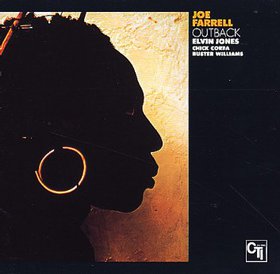
:::Outback:::

Posted: Tuesday, 10 May 2011 by jazzlover in Etykiety: , , , ,
2

Outback is the second of his dates for the CTI label, all of which are compelling, and some, like this one, are brilliant. Recording in a quartet setting with Elvin Jones, Chick Corea, and Brazilian percussionist Airto Moreira, Farrell, with his reeds and woodwinds, pushes the envelope not only of his own previous conceptualism in jazz, but the CTI label's envelope as well. For starters, this is not a funk, soul, or fusion date, but an adventurous, spacy tightrope-walking exercise between open-ended composition and improvisation. That said, there is plenty of soul in the playing, not only by Farrell, but by all the players -- and Corea never sounded less academic or pointillistic than he does here.
There are four compositions on Outback, all of which were arranged by Farrell. The opener is the humid and mysterious title track by John Scott.
Staged in a series of minor-key signatures, Farrell primarily uses his winds here, flutes and piccolos, to weave a spellbinding series of ascending melodies over the extended voicings provided by Corea -- not exactly in counterpoint, but in spacious contrast. Jones is his typically uncanny self, skipping over cymbals and using a set of sticks more softly than any man can and still drive a band. Airto is positively hypnotic with his hand-drum fills, rubs and shimmers, going through the beat, climbing on top of it, and playing accents in tandem with Farrell in the solo sections. "Sound Down" is a bit more up-tempo and features Farrell fully engaged on the soprano. Buster Williams lays down a short staccato bassline that keeps Jones' bass drum pumping. As Farrell moves from theme/variation/melody to improvisation, he brings Corea, who, uncharacteristically, vamps off the melody before offering a series of ostinato replies before Farrell clearly surprises everybody with the knottiness of his legato phrasing. Corea's "Bleeding Orchid" is a ballad played with augmented modes and continually shifting intervals that can be heard and mapped best by Williams' adherence to the changes, though his pizzicato fills provide a sharp contrast to Farrell's trills and columnar arpeggiattic meditations that come off as a cross between pastoral jazz classicism and Middle Eastern folk music. Finally, on the leader's own "November 6th," the stops are pulled out in a Latin jazz workout that invokes Coltrane's version of "My Favorite Things," and Farrell digs deep into the tenor's middle register for a singing sound that brings to bear the Latin jazz howling of Gato Barbieri and the deep fire music of 'Trane, while being played through a gorgeously bluesy sophistication as the other players rally around and push through the tenor player's flights of near manic intensity. This is a stunner, an album that is at least as inspired as anything Farrell ever recorded, and perhaps more so.
:::Review by Thom Jurek:::

Joe Farrell - Outback (1971)

1. Outback (From The Motion Picture "Outback"), Composed By – J. Scott, 8:40
2. Sound Down, Composed By – G. Farrell, J. Farrell, 8:30
3. Bleeding Orchid, Composed By – C. Corea, 6:45
4. November 68th, Composed By – J. Farrell, 9:25

Credits
Bass – Buster Williams
Drums – Elvin Jones
Electric Piano – Chick Corea
Percussion – Airto Moreira
Saxophone [Soprano, Tenor], Flute, Flute [Alto, Piccolo] – Joe Farrell

:::Organ-Keys #1:::

Posted: Monday, 11 October 2010 by jazzlover in Etykiety: , , , , , ,
2

Before changing label, Hancock had to record one more album with Mwandishi, and it came in early 73, when he did the soundtrack music of the very confidential film The Spook Who Sat By The Door, for which both Hancock and Rubinson (his producer) added funds to finish it. Someday maybe, this soundtrack will get an official release. The third and last album of the Mwandishi trilogy is the first album Hancock recorded for his new label Columbia (home of all the electric jazz rock stars) in the spring 73 and the least we can say is that the closing tier of the said-trilogy is definitely no easier on the ears than its precessors. Going through Hancock's discography in the racks of the record store, the proghead's attention can only be drawn and stop his eyes on this album's stupendous artwork, courtesy of Stringett (already responsible for Crossings), and the proghead will immediately know that this is Herbie's most progressive album (along with Crossings). Indeed Herbie was still following Miles' Bitches Brew's footsteps and that album's awesome artwork proves it. So the potential Hancock investigators will normally head towards Sextant and Crossings, the Mwandishi albums closest to Miles' Bitches.
With an unchanged line-up, the sextet attacks Sextant as if they were in the middle of a song from the previous album Crossings. And the least we can say is that Rain Dance is probably one of Hancock's most hermetic tracks he ever wrote. Completely experimental with electronic sounds that could've escaped from Isao Tomita's soundscape albums, the song is close to nightmarish and presents some Krautrock reminiscence ala Can or early TD. Somehow, this track is also reminiscent of Genesis' Waiting Room on the Lamb album. Indeed these gloomy sounds from outer space come from their seventh member Patrick Gleason and he's never been so present than on Rain Dance. He's also fairly present in the following Hidden Shadows, busy with a mellotron (among others), while Maupin pulls out some superb sounds from his wide array of horns. Outstanding stuff, making you forget the previous track's obtuse stand on in/excluding the listener.
The flipside is again taken by a sidelong track, the almost 20-mins Hornets, one of his funkiest so far (wait 'till HH, to see/hear funk), but the tracks has moments that evoke indeed a flight of hornets. Musically it's halfway between Rain Dance and Shadows, but it's overstaying its welcome by at least 5 minutes.
Hancock himself has turned towards the synths and with Gleeson, they started using loops
Again faced with public incomprehension, Sextant failed to sell anymore than the other two Mwandishi albums on WB. But this time it was clear that HH's troupes were now struggling to find further grounds to explore and were starting to repeat themselves. With albums selling too few, an irregular public presence and questionable gigs (even finding The Pointer Sister as openers), stolen tapes in front of the Vanguard Village and the usual road fatigue, the group So Herbie folded Mwandishi and his next project would be bringing him exactly what lacked this one: commercial success. In the meantime, Sextant is probably the least "accessible" Mwandishi album, but it's no less worthy and maybe my preferred one.
:::Review by Sean Trane:::

Herbie Hancock – Sextant (1972)

1. Rain Dance (9:18)
2. Hidden Shadows (10:12)
3. Hornets (19:31)

Credits
- Herbie Hancock - piano, Fender Rhodes, Hohner D-6 clavinet, mellotron
- Bennie Maupin - soprano sax, bass clarinet, piccolo, afuche, hum-a-zoo
- Dr. Eddie Henderson - trumpet, flugelhorn
- Julian Priester - bass trombone, tenor trombone, alto trombone, cowbell
- Buster Williams - electric bass, acoustic bass
- Billy Hart - drums
- Dr. Patrick Gleeson - ARP 2600 and soloist
- Buck Clarke - percussion

:::Trumpet #1:::

Posted: Friday, 8 October 2010 by jazzlover in Etykiety: , , , , , , , ,
2

Switching over to Blue Note, which was then reaping a fortune with Donald Byrd's R&B outfit, Eddie Henderson pursued a harder, earthier, more structured, funk-driven sound on his first album, while maintaining some of his marvelously spacier instincts for spice. Henderson continued to keep several components of the Herbie Hancock Septet together, for drummer Billy Hart, bassist Buster Williams, reedman Bennie Maupin, and now trombonist Julian Priester are back. But this time, Hancock is replaced by George Duke, and fusionaire bassist Alphonso Johnson and drummer Harvey Mason (late of the Headhunters) are added -- and these switches make much of the difference. Duke is as much of an techie as Herbie was; he delights in flaunting his Echoplex and burbling, shooting, twinkling synthesizer effects. Henderson himself is more into electronic echo and wah-wah effects than before, definitely pursuing the current Miles Davis line but in a brighter, more tonally brilliant manner, and Maupin has many impassioned and creepy (on bass clarinet) moments. The title track, a ruminative Henderson tune with a leaping funk beat, and Mason's archetypical funk workout "Hop Scotch" are the best cuts.
:::Review by Richard S. Ginell:::

Eddie Henderson - Sunburst (1975)

1. Explodition (6:34)
2. The Kumquat Kids (4:30)
3. Sunburst (5:46)
4. Involuntary Bliss (6:49)
5. Hop Scotch (3:52)
6. Galaxy (6:35)
7. We End In A Dream (3:10)

Credits
- Buster Williams / acoustic bass
- Alphonso Johnson / electric bass, effects
- Billy Hart / drums
- Harvey Mason / drums
- George Duke / electric piano, clavinet, synthesizer
- Bobby Hutcherson / marimba
- Bennie Maupin / saxophone, bass clarinet, tenor saxophone, saxcello, bass clarinet
- Julian Priester / trombone, post horn
- Eddie Henderson / trumpet, flugelhorn, cornet

Other personnel
- Fred Catero / recording and remix engineer
- George Horn / mastering
-Skip Drinkwater / producer

Notes
1975 Vinyl LP, Sunburst, United States , Blue Note BN-LA464-G
2002 CD, Sunburst [Rare Groove Series] [Remastered], United States, Blue Note 7243 5 38698 2 3
Recorded and mixed at Wally Heider Recording Studios in San Francisco in March and April 1975

:::Inside Out:::

Posted: Thursday, 30 July 2009 by jazzlover in Etykiety: , , , , , ,
9


The Herbie Hancock Septet was technically out of business around this time, superseded by the Headhunters, yet the group shouldered on briefly in the studio for a second album under the leadership of its trumpeter, Eddie Henderson. With Bennie Maupin back on a variety of reeds, Hancock on electric keyboards, Patrick Gleeson on synthesizers, Buster Williams on bass, and Billy Hart on drums, Henderson again had rounded up everyone in the group except Julian Priester, adding second drummer Eric Gravatt (from Weather Report) and Bill Summers (from the Headhunters) on congas. One can feel the funky influence of the Headhunters entering the building, particularly in the basslines and Hancock's wah-wah keyboard work, but this is still very much the music of the Septet -open-ended and almost free, heavily electronic, spiritual in intent, and enormously stimulating. Although Henderson and Maupin control the repertoire, the trumpeter continues to interact virtually as an equal among equals, sounding more haunting and free-floating now. Drier in texture and less frantically driven than Realization (its Capricorn label predecessor), Inside Out nevertheless is the de facto swan song of one of the great bands of jazz-rock.
:::Review by Richard S. Ginell:::

Eddie Henderson - Inside Out (1973)

1. Moussaka 8:59
2. Omnipresence 2:14
3. Discoveries 5:08
4. Fusion 3:33
5. Dreams 7:21
6. Inside Out 9:25
7. Exit #1 2:54

Credits
Bass, Bass [Fender] - Buster Williams
Clarinet, Clarinet [Bass], Flute, Flute [Alto], Piccolo Flute, Saxophone [Tenor] - Bennie Maupin
Congas - Bill Summers
Drums - Billy Hart , Eric Gravatt
Piano [Electric], Clavinet, Organ - Herbie Hancock
Producer - Skip Drinkwater
Synthesizer - Patrick Gleeson
Trumpet, Flugelhorn, Cornet - Eddie Henderson

:::The Moontrane:::

Posted: Thursday, 7 May 2009 by jazzlover in Etykiety: , , , , ,
3


In a genre full of tragically short-lived performers, Woody Shaw's story is exceptionally tragic. Legally blind and beset with emotional problems, he was killed in a subway accident in 1989 without ever attaining the recognition attentive listeners knew he deserved. The Mosaic box set of his Columbia recordings a few years ago placed him in a linear development of trumpet players between Hubbard and Marsalis; this was, no doubt, a highly questionable analysis (mainly because it left out Miles Davis altogether), but it indicated the high regard and influence Shaw has had — or should have had — over other trumpet players.
The Moontrane, recorded in late 1974, was Shaw's breakthrough album. It is aptly named, for although Shaw was during his lifetime routinely (and with relative inaccuracy) compared to Hubbard, he sounds more like John Coltrane. Now to replicate Coltrane's lightning runs and dense harmonic lines on trumpet is no mean feat; Shaw not only does it repeatedly, but with impeccable precision and taste. The Moontrane sports the Coltrane-ish tenor and soprano man Azar Lawrence, who was also part of McCoy Tyner's Coltrane-ish modal recordings of the early Seventies.
"Sanyas," by a young Steve Turre, who is also part of Shaw's basic quartet, is a modal workout with some intense soprano work by Lawrence, recalling the reedy Eastern feel of many of Coltrane's soprano recordings. Shaw is simply stunning here, with long clean lines to take the breath away. Then comes pianist Onaje Allen Gumbs, a Shaw favorite, playing unplugged on this track a first-rate McCoy Tyner impersonation. Cecil McBee plays bass on three tracks, Buster Williams on two. (There are also two alternates, both featuring McBee.) Victor Lewis on drums keeps things going, but doesn't light any fires. Percussionists Tony Waters and Guilherme Franco join in here and there.
"The Moontrane" became Shaw's signature tune. Here it gets a straightforward reading enlivened by the sterling trumpet of the master himself. "Tapscott's Blues" is more passionate, with Lawrence and Shaw vying intriguingly for Best Post-Coltrane Solo honors. Turre sounds throughout the disc a little less developed than the trombonist he has subsequently become, but that doesn't mean he doesn't hold up his end. Actually, as the only one of the frontmen not to be deeply influenced by the Coltrane Quartet, he adds piquancy to the sound.
"Katrina Ballerina" is a boppish tune with more stunning work from Shaw, whose fluency in the trumpet's lower register is just as striking as his speed.
Gumbs shines on his own "Are They Only Dreams," as does Turre on the opening sections of his "Sanyas." Shaw himself penned "The Moontrane" and "Katrina Ballerina," putting him in the group of great jazz performers who could write their own great tunes. Alas that he didn't write more.
:::Review by Robert Spencer:::

Woody Shaw - The Moontrane (1975)

1. The Moontrane (6:54)
2. Sanyas (13:05)
3. Tapscott´s Blues (6:41)
4. Katrina Ballerina (7:36)
5. Are They Only Dreams (9:12)
6. Tapscott´s Blues (Alt.) (6:50)
7. Katrina Ballerina (Alt.) (8:01)

Credits
Artwork By [Graphic Design] - Nancy Dwyer , Page Simon
Bass - Buster Williams (tracks: 1, 5) , Cecil McBee (tracks: 2 to 4, 6, 7)
Congas - Tony Waters (tracks: 2, 4, 5, 7)
Drums - Victor Lewis
Electric Piano - Onaje Allen Gumbs
Engineer - Eddie Korvin , Jan Rathburn
Mastered By - Gene Paul
Other [Production Coordinator] - Michael Weiner
Percussion - Guilherme Franco (tracks: 2, 4, 5, 7)
Photography [Photo Illustrations] - Oliver Wasow
Piano - Onaje Allen Gumbs
Producer - Michael Cuscuna
Producer [Series Produced By] - Joel Dorn
Saxophone [Soprano] - Azar Lawrence
Saxophone [Tenor] - Azar Lawrence
Trombone - Steve Turre
Trumpet - Woody Shaw

:::The Quintet:::

Posted: Wednesday, 23 July 2008 by jazzlover in Etykiety: , , , , , , , , ,
2

With the cheers and huzzahs from their 1976 one-off reunion still resounding, the reconstituted Miles Davis Quintet minus Miles went on the road in 1977, spreading their 1965-vintage gospel according to the Prince of Darkness to audiences in Berkeley and San Diego, CA. In doing so, Herbie Hancock, Wayne Shorter, Ron Carter, and Tony Williams, plus interloper Freddie Hubbard seem to pick up where they left off, with a repertoire mostly new to the five collectively and developed from there. It isn't exactly the same -- you miss Miles' brooding presence and sense of space in Hubbard's busy, fiery playing, and Hancock is a more harmonically daring, assertive player than he was with Miles -- but the interlocking telepathy and individual virtuosity of the musicians is pretty amazing. This also isn't the best tape from the tour; they were even tighter and more volatile in Japan five days later on Sony's Tempest in the Colosseum. The V.S.O.P. tours amount to a pit stop in the general shape of Hancock's evolution, but their influence upon the direction of jazz as a whole in the '80s and '90s would be staggering.
:::By Richard S. Ginell:::
 
V.S.O.P. - The Quintet (1977)

1. One Of A Kind
2. Third Plane
3, Jessica
4, Lawra
5. Introduction Of Players, Darts
6. Dolores
7. Little Waltz
8. Byrdlike

Credits
Ron Carter (Bass), Herbie Hancock (Synthesizer), Herbie Hancock (Piano), Herbie Hancock (Keyboards), Herbie Hancock (Vocals), Herbie Hancock (Main Performer), Bennie Maupin (Percussion), Bennie Maupin (Wind), Julian Priester (Trombone), Wayne Shorter (Saxophone), Wayne Shorter (Sax (Soprano)), Wayne Shorter (Sax (Tenor)), Tony Williams (Drums), Eddie Henderson (Percussion), Eddie Henderson (Trumpet), V.S.O.P. (Performer), Conrad Silvert (Liner Notes), Bryan Bell (Engineer), Bryan Bell (Audio Engineer), Fred Catero (Engineer), Jeffrey Cohen (Associate Producer), Freddie Hubbard (Trumpet), Freddie Hubbard (Flugelhorn), Paul Jackson (Bass), James Levi, Chris Minto (Assistant Engineer), Shawn Murphy (Remote Recording Crew), David Rubinson (Producer), Ray Thompson (Remote Recording Crew), Wah Wah Watson (Guitar), Buster Williams (Bass), Buster Williams (Percussion), Herbie Green (Design), Paul Sandweiss (Remote Recording Crew), Bruce Talamon (Photography), Dennis Mays (Remote Recording Crew), Russ Anderson (Design), Les D. Cooper (Remote Recording Crew)

Notes
Recorded live at: The Greek Theatre University of California, Berkeley, July 16, 1977 and The San Diego Civic Theatre, July 18, 1977.