




:::Outback:::
Posted: Tuesday, 10 May 2011 by jazzlover in Etykiety: Airto Moreira, Buster Williams, Chick Corea, Elvin Jones, Joe Farrell
2
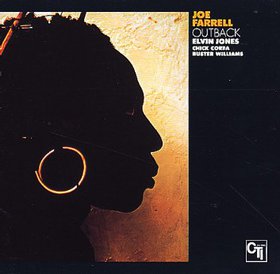
Outback is the second of his dates for the CTI label, all of which are compelling, and some, like this one, are brilliant. Recording in a quartet setting with Elvin Jones, Chick Corea, and Brazilian percussionist Airto Moreira, Farrell, with his reeds and woodwinds, pushes the envelope not only of his own previous conceptualism in jazz, but the CTI label's envelope as well. For starters, this is not a funk, soul, or fusion date, but an adventurous, spacy tightrope-walking exercise between open-ended composition and improvisation. That said, there is plenty of soul in the playing, not only by Farrell, but by all the players -- and Corea never sounded less academic or pointillistic than he does here.
There are four compositions on Outback, all of which were arranged by Farrell. The opener is the humid and mysterious title track by John Scott.
Staged in a series of minor-key signatures, Farrell primarily uses his winds here, flutes and piccolos, to weave a spellbinding series of ascending melodies over the extended voicings provided by Corea -- not exactly in counterpoint, but in spacious contrast. Jones is his typically uncanny self, skipping over cymbals and using a set of sticks more softly than any man can and still drive a band. Airto is positively hypnotic with his hand-drum fills, rubs and shimmers, going through the beat, climbing on top of it, and playing accents in tandem with Farrell in the solo sections. "Sound Down" is a bit more up-tempo and features Farrell fully engaged on the soprano. Buster Williams lays down a short staccato bassline that keeps Jones' bass drum pumping. As Farrell moves from theme/variation/melody to improvisation, he brings Corea, who, uncharacteristically, vamps off the melody before offering a series of ostinato replies before Farrell clearly surprises everybody with the knottiness of his legato phrasing. Corea's "Bleeding Orchid" is a ballad played with augmented modes and continually shifting intervals that can be heard and mapped best by Williams' adherence to the changes, though his pizzicato fills provide a sharp contrast to Farrell's trills and columnar arpeggiattic meditations that come off as a cross between pastoral jazz classicism and Middle Eastern folk music. Finally, on the leader's own "November 6th," the stops are pulled out in a Latin jazz workout that invokes Coltrane's version of "My Favorite Things," and Farrell digs deep into the tenor's middle register for a singing sound that brings to bear the Latin jazz howling of Gato Barbieri and the deep fire music of 'Trane, while being played through a gorgeously bluesy sophistication as the other players rally around and push through the tenor player's flights of near manic intensity. This is a stunner, an album that is at least as inspired as anything Farrell ever recorded, and perhaps more so.
There are four compositions on Outback, all of which were arranged by Farrell. The opener is the humid and mysterious title track by John Scott.
Staged in a series of minor-key signatures, Farrell primarily uses his winds here, flutes and piccolos, to weave a spellbinding series of ascending melodies over the extended voicings provided by Corea -- not exactly in counterpoint, but in spacious contrast. Jones is his typically uncanny self, skipping over cymbals and using a set of sticks more softly than any man can and still drive a band. Airto is positively hypnotic with his hand-drum fills, rubs and shimmers, going through the beat, climbing on top of it, and playing accents in tandem with Farrell in the solo sections. "Sound Down" is a bit more up-tempo and features Farrell fully engaged on the soprano. Buster Williams lays down a short staccato bassline that keeps Jones' bass drum pumping. As Farrell moves from theme/variation/melody to improvisation, he brings Corea, who, uncharacteristically, vamps off the melody before offering a series of ostinato replies before Farrell clearly surprises everybody with the knottiness of his legato phrasing. Corea's "Bleeding Orchid" is a ballad played with augmented modes and continually shifting intervals that can be heard and mapped best by Williams' adherence to the changes, though his pizzicato fills provide a sharp contrast to Farrell's trills and columnar arpeggiattic meditations that come off as a cross between pastoral jazz classicism and Middle Eastern folk music. Finally, on the leader's own "November 6th," the stops are pulled out in a Latin jazz workout that invokes Coltrane's version of "My Favorite Things," and Farrell digs deep into the tenor's middle register for a singing sound that brings to bear the Latin jazz howling of Gato Barbieri and the deep fire music of 'Trane, while being played through a gorgeously bluesy sophistication as the other players rally around and push through the tenor player's flights of near manic intensity. This is a stunner, an album that is at least as inspired as anything Farrell ever recorded, and perhaps more so.
:::Review by Thom Jurek:::
Joe Farrell - Outback (1971)
1. Outback (From The Motion Picture "Outback"), Composed By – J. Scott, 8:40
2. Sound Down, Composed By – G. Farrell, J. Farrell, 8:30
3. Bleeding Orchid, Composed By – C. Corea, 6:45
4. November 68th, Composed By – J. Farrell, 9:25
Credits
Bass – Buster Williams
Drums – Elvin Jones
Electric Piano – Chick Corea
Percussion – Airto Moreira
Saxophone [Soprano, Tenor], Flute, Flute [Alto, Piccolo] – Joe Farrell
Joe Farrell - Outback (1971)
1. Outback (From The Motion Picture "Outback"), Composed By – J. Scott, 8:40
2. Sound Down, Composed By – G. Farrell, J. Farrell, 8:30
3. Bleeding Orchid, Composed By – C. Corea, 6:45
4. November 68th, Composed By – J. Farrell, 9:25
Credits
Bass – Buster Williams
Drums – Elvin Jones
Electric Piano – Chick Corea
Percussion – Airto Moreira
Saxophone [Soprano, Tenor], Flute, Flute [Alto, Piccolo] – Joe Farrell


