:::Blackstone Legacy:::

Posted: Thursday, 23 February 2012 by jazzlover in Etykiety: , , , , , ,
1

Originally a two-fer on vinyl and now on one CD, Shaw's debut as a leader is one of the first "free bop" sessions, in many ways his answer to Bitches Brew. The trumpeter's ensemble extracts dense, energetic, meaty collective sounds based in pure improvisation with a skeleton of a rhythmic framework to expound upon. Saxophonists Gary Bartz & Bennie Maupin, electric pianist George Cables, twin bassists Ron Carter and Clint Houston, and drummer Lenny White respond to Shaw's heavy direction, making for some of the most kinetic jazz heard in that period of early fusion. Shaw's bright melodicism, hard edged swing and refusal to compromise are his greatest assets. They come shining through on tuneful classics like the unstoppable "Think On Me" and stop-start gymnastics of "Boo-Ann's Grand." It represents the progressive bop aesthetic at a fever pitch. The title track is as wild and wooly as Woody could be, while "Lost & Found" is free bop at its finest. "New World" is a free funk number, quite a trend setter for its time, while "A Deed For Dolphy" shows an abstract, no-time side rarely heard from Shaw. All tunes are quite lengthy, no shorter than nine, no longer than seventeen minutes. This allows the band to develop their ideas and interact in a manner more akin to a concert setting. Bartz (alto and soprano saxophone) and Maupin (tenor saxophone, bass clarinet and flute) consistently show why they are two of the best improvising jazzmen out there. As much as the music is the thing, it is the singular presence of Shaw that refracts many colors of light and dark, like a multi-hued beacon directing many ships to port. There is not a better example of this music from its inception, documented on tape, than this other worldly session that brought the trumpeter to the jazz world's attention. Furthermore, few have done it better since. Truly a landmark recording, and a pivot point in the history of post-modern music.
:::Review by Michael G. Nastos:::

Woody Shaw - Blackstone Legacy (1970)

1. Blackstone Legacy 16:08
2. Think On Me 10:49
3. Lost And Found 10:45
4. New World 17:06
5. Boo-Ann's Grand 14:25
6. A Deed For Dolphy 8:56

Credits
Alto Saxophone, Soprano Saxophone – Gary Bartz
Bass – Ron Carter
Bass [Electric] – Clint Houston
Drums – Lenny White
Piano, Piano [Electric] – George Cables
Tenor Saxophone, Clarinet [Bass], Flute – Bennie Maupin
Trumpet – Woody Shaw

:::Es Em, Ekel Em:::

Posted: Monday, 20 February 2012 by jazzlover in Etykiety:
1

Godzik Pink was a RIO/Avant-Prog band formed in 1996 in Los Angeles, California. The band consisted of Ara Shirinyan (guitar), Eric Kiersnowski (bass), Jonathan Silberman (tenor saxophone), and Nigel Lundemo (drums). Godzik Pink blended alternative rock, jazz and pop to create their complex and highly original sound. They released three EP albums before disbanding. This high energy band is recommended to fans of punk-prog aka pronk and avantjazz.
:::Review by Evolutionary Sleeper:::

Godzik Pink - Es Em, Ekel Em (2009)

1. Lifting for the Lord (2:55)
2. Fardray'n Akopf (1:29)
3. Several dogs (1:53)
4. Sonna Vonda Beech (2:03)
5. Es Em, Ekel Em (2:18)
6. Mourning Wood (2:50)
7. You're in the Jungle Baby (3:23)


Credits
- Ara Shirinyan / guitar
- Eric Kiersnowski / bass
- Jonathan Silberman / tenor saxophone
- Nigel Lundemo / drums

:::Disco Volante:::

Posted: Saturday, 22 October 2011 by jazzlover in Etykiety: , , , , , , ,
3

Mr. Bungle, for me, one of the most important bands ever. This album, ABSOLUTELY GREAT, with the exception of "The Bends", which doesn't warrant anything intersting and is basically annoying. The rest of the songs: all great. I would've loved to have given this 5 stars, but blame it on "the Bends".
This album came so unexpectedly. Their self-titled debut was somewhat commercially acceptable, this album is one of the most anti-commercial albums in recorded history. Completely bizaare sounds cascade from crag-jagged towering monoliths of insanity. The musical styles range from tango, jazz, techno, death metal, surf rock, and sounds probably undiscernible from the creators themselves. "Everyone I Went to High School with is Dead" contains morbid lyrics and the vocals sound like they're done by the dead classmates. "Carry Stress in the Jaw" is perhaps the heavist track, going in and out of speed and death metal bursts colliding into vocal excursions that resound as if they were sung in the deeps of a cave. The time signatures are astonishing on the album throughout. "Violenza Domestica" is an italian song about domestic violence with great vocals by Mike Patton. The talent of the musician's is incredible, all exemplifying great range. "Ma Meeshka Mow Skowz" is in a language all their own (I hope). "The Bends" is the most astonishingly topsy-turvy "song" I've ever heard. "Platypus" is a very humrous and immensely technical song about, you guessed it the platypus. The album ends with "Merry Go Bye Bye" which begins as surf-rock normality (excluding the lyrical subject matter which is about suicide) and then descends into feral madness (the vocal abilities resemble a plane taking off, repeatedly). The song then goes in roller coaster mode for the remainder having a very gentle and poignant moment before being raped by the cacophony of musical din. The hidden stuff at the very end of the album is very loud and frightening if your trying to listen to the album before going to bed (not recommended; it will wake you right up, violently). Highly recommended album for fans of original musicians with integrity and skill.
:::Review by billyshears'67:::

Mr. Bungle - Disco Volante (1995)

1. Everyone I Went To High School With Is Dead (2:44)
2. Chemical Marriage (3:09)
3. Sleep (Part II): Carry Stress In The Jaw (8:59)
4. Desert Search For Techno Allah (5:24)
5. Violenza Domestica (5:14)
6. After School Special (2:47)
7. Sleep (Part III): Phlegmatics (3:16)
8. Ma Meeshka Mow Skowz (6:06)
9. The Bends (10:28)
...1) Man Overboard
...2) The Drowning Flute
...3) Aqua Swing
...4) Follow The Bubbles
...5) Duet For Guitar and Oxygen Tank
...6) Nerve Damage
...7) Screaming Bends
...8) Panic
...9) Love On The Event Horizon
...10) Re-Entry
10. Backstrokin' (2:27)
11. Platypus (5:07)
12. Merry Go Bye Bye (12:58)

Credits
- Trevor Dunn / bass
- Mike Patton / organ, ocarina, vocals, microcassette
- William Winant / percussion, bongos, cymbals, glockenspiel, Jew's-Harp, tabla, xylophone, kanjira, sistrum
- Graham Connah / piano
- Theobald Brooks Lengyel / reeds (multiple)
- Clinton McKinnon / clarinet, drums, keyboards
- I Quit / percussion, wood block
- Lisandro Adrover / bandoneon
- Trey Spruance / pipa, keyboards/organs, guitar, electronics

:::Flyin’ Lady:::

Posted: Tuesday, 18 October 2011 by jazzlover in Etykiety: , , ,
1

JAN "PTASZYN" WROBLEWSKI [YAHN PTOSH-shin vroo-BLEFF-ski] Polish tenor saxophonist and composer. Wróblewski is the one of the first Polish musicians who started playing in a free-jazz style and, although later he used a more traditional approach, he remained open to musical experimentation. Some of his compositions are influenced by Polish folk music.This LP was recorded in Warsaw in 1978. Jan Ptaszyn Wróblewski Quartet: Andrzej Dąbrowski (dr), Jan Ptaszyn Wróblewski (ts), Witold Szczurek (cb), Marek Bliziński (g).
:::Taken from nme.com:::

Jan Ptaszyn Wróblewski Quartet – Flyin’ Lady (Polish Jazz vol. 55) (1978)

Side A
1. Pastuszek Stomp
2. Grzmot nad ranem
3. Bossa Nostra

Side B
1. Pani Ptakowa
2. Dlaczego małpa...
3. Licheć Checioł Dana

Credits
Jan “Ptaszyn” Wróblewski – tenor sax
Marek Bliziński – guitar
Witold Szczurek – bass
Andrzej Dąbrowski – drums

:::Jaco Pastorius:::

Posted: Monday, 17 October 2011 by jazzlover in Etykiety: , , , , , , , ,
4

It's impossible to hear Jaco Pastorious' debut album today as it sounded when it was first released in 1976. The opening track -- his transcription for fretless electric bass of the bebop standard "Donna Lee" -- was a manifesto of virtuosity; the next track, the funk-soul celebration "Come On, Come Over" was a poke in the eye to jazz snobs and a love letter to the R&B greats of the previous decade (two of whom, Sam & Dave, sing on that track); "Continuum" was a spacey, chorus-drenched look forward to the years he was about to spend playing with Weather Report. The program continues like that for three-quarters of an hour, each track heading off in a different direction -- each one a masterpiece that would have been a proud achievement for any musician. What made Jaco so exceptional was that he was responsible for all of them, and this was his debut album. Beyond his phenomenal bass technique and his surprisingly mature compositional chops (he was 24 when this album was released), there was the breathtaking audacity of his arrangements: "Okonkole Y Trompa" is scored for electric bass, French horn, and percussion, and "Speak Like a Child," which Pastorious composed in collaboration with pianist Herbie Hancock, features a string arrangement by Pastorious that merits serious attention in its own right. For a man with this sort of kaleidoscopic creativity to remain sane was perhaps too much to ask; his gradual descent into madness and eventual tragic death are now a familiar story, one which makes the bright promise of this glorious debut album all the more bittersweet. (This remastered reissue adds two tracks to the original program: alternate takes of "(Used to Be a) Cha Cha" and "6/4 Jam").
:::Review by Rick Anderson:::

Jaco Pastorius - s/t (1976)
1. Donna Lee 2:28
Electric Bass – Jaco Pastorius
Congas – Don Alias
Written-By – C. Parker

2. Come On, Come Over 3:52
Electric Bass – Jaco Pastorius
Trombone [Bass] – Peter Graves
Saxophone [Baritone] – Howard Johnson
Clavinet, Electric Piano [Fender Rhodes] – Herbie Hancock
Saxophone [Tenor] – Michael Brecker
Written-By – B. Herzog, J. Pastorius
Vocals – Dave Pratter, Sam Moore
Drums – Narada Michael Walden
Featuring – Sam & Dave
Trumpet – Randy Brecker, Ron Tooley
Congas – Don Alias
Saxophone [Alto] – David Sanborn

3. Continuum 4:33
Written-By – J. Pastorius
Electric Bass – Jaco Pastorius
Electric Piano [Fender Rhodes] – Alex Darqui, Herbie Hancock
Drums – Lenny White
Bells – Don Alias

4. Kuru/Speak Like A Child 7:42
Electric Bass – Jaco Pastorius
Cello – Beverly Lauridsen, Charles McCracken, Kermit Moore
Viola – Manny Vardi, Julian Barber, Stewart Clarke
Arranged By [String Arrangement] – Jaco Pastorius
Violin – David Nadien, Harold Kohon, Harry Cykman, Harry Lookofsky, Joe Malin, Paul Gershman
Drums – Bobby Economou
Bongos, Congas – Don Alias
Concertmaster – David Nadien
Piano – Herbie Hancock
Written-By – H. Hancock, J. Pastorius
Conductor [Strings] – Michael Gibbs

5. Portrait Of Tracy 2:22
Electric Bass – Jaco Pastorius
Written-By – J. Pastorius

6. Opus Pocus 5:29
Saxophone [Soprano] – Wayne Shorter
Electric Bass – Jaco Pastorius
Electric Piano [Fender Rhodes] – Herbie Hancock
Steel Drums – Leroy Williams, Othello Molineaux
Written-By – J. Pastorius
Percussion – Don Alias
Drums – Lenny White

7. Okonkole Y Trompa 4:25
French Horn – Peter Gordon
Electric Bass – Jaco Pastorius
Bata [Okonkolo Iya], Congas, Cabasa [Afuche] – Don Alias
Written-By – D. Alias, J. Pastorius

8. (Used To Be A) Cha-Cha 8:57
Electric Bass – Jaco Pastorius
Written-By – J. Pastorius
Flute [Piccolo] – Hubert Laws
Drums – Lenny White
Piano – Herbie Hancock
Congas – Don Alias

9. Forgotten Love 2:14
Electric Bass – Jaco Pastorius
Viola – Al Brown, Manny Vardi, Julian Barber, Stewart Clarke
Arranged By [String Arrangement] – Jaco Pastorius
Written-By – J. Pastorius
Double Bass – Homer Mensch, Richard Davis
Cello – Alan Shulman, Beverly Lauridsen, Charles McCracken, Kermit Moore
Violin – Arnold Black, David Nadien, Harold Kohon, Harry Cykman, Harry Lookofsky, Joe Malin, Matthew Raimondi, Max Pollikoff, Paul Gershman
Concertmaster – David Nadien
Piano – Herbie Hancock
Conductor [Strings] – Michael Gibbs

Bonus Tracks (Previously Unreleased)

10. (Used To Be A) Cha-Cha 8:49
Electric Bass – Jaco Pastorius
Written-By – J. Pastorius
Flute [Piccolo] – Hubert Laws
Drums – Lenny White
Piano – Herbie Hancock
Congas – Don Alias

11. 6/4 Jam 7:45
Written-By – J. Pastorius
Electric Bass – Jaco Pastorius
Congas – Don Alias
Drums – Lenny White
Electric Piano [Fender Rhodes] – Herbie Hancock

:::The Rumproller:::

Posted: Sunday, 16 October 2011 by jazzlover in Etykiety: , , , ,
1

To follow up on his unexpected boogaloo hit "The Sidewinder," Lee Morgan recorded Andrew Hill's somewhat similar "The Rumproller" but this time the commercial magic was not there. However the trumpeter, tenor-saxophonist Joe Henderson, pianist Ronnie Mathews, bassist Victor Sproles and drummer Billy Higgins all play quite well on the title cut, two of Morgan's songs (the bossa nova "Eclipso" is somewhat memorable), a ballad tribute to Billie Holiday and Wayne Shorter's "Edda." This album is worth picking up but it is not essential.
:::Review by Scott Yanow:::

Lee Morgan - The Rumproller (1965)

1. The Rumproller 10:26
Written-By – Andrew Hill
2. Desert Moonlight 9:22
Written-By – Lee Morgan
3. Eclipso 6:53
Written-By – Lee Morgan
4. Edda 7:19
Written-By – Wayne Shorter
5. The Lady 7:30
Written-By – Rudy Stevenson
6. Venus Di Mildrew 6:26
Written-By – Wayne Shorter

Credits
Bass – Victor Sproles
Drums – Billy Higgins
Piano – Ronnie Mathews
Tenor Saxophone – Joe Henderson
Trumpet – Lee Morgan

:::Home Is Where The Music Is:::

Posted: Wednesday, 12 October 2011 by jazzlover in Etykiety: , , , ,
1

Released as a double LP on Chisa/Blue Thumb in 1972, Hugh Masekela's Home Is Where the Music Is marked an accessible but sharp detour from his more pop-oriented jazz records of the '60s. Masekela was chasing a different groove altogether. He was looking to create a very different kind of fusion, one that involved the rhythms and melodies of his native South Africa, and included the more spiritual, soul-driven explorations occurring in American music at the time on labels like Strata East, Tribe, and Black Jazz as well as those laid down by Gato Barbieri on Bob Thiele's Flying Dutchman imprint. The South African and American quintet he assembled for the date is smoking. It includes the mighty saxophonist Dudu Pakwana and drummer Makaya Ntshoko, both South African exiles; they were paired with American pianist Larry Willis and bassist Eddie Gomez, creating a wonderfully balanced, groove-oriented ensemble. Produced by Stewart Levine and composer Caiphus Semenya, this is a near mythic date that was reviewed favorably but infrequently back in the day.
The ten tunes here range between five and 11 minutes; half were written by Semenya, Masekela and Willis wrote one apiece, and the balance were covers -- including a gorgeous arrangement of Miriam Makeba's "Uhomé." "Part of the Whole"opens the set with Willis on Fender Rhodes piano, with a lazy rolling blues groove that is equal parts soul-jazz and South African folk melody. The horns enter behind him playing a vamp before they ramp it up in the chorus twice before Pakwana takes his solo against the rhythm section. Willis' sense of time is indomitable and the funky breaks laid down by Ntshoko are beautifully balanced by Gomez's woody tone. Pakwana wails emotionally, swerving between post-bop and more free explorations. Masekela answers his solo on his flugelhorn in tight, hard blues lines. His flight remains inside with the rhythm section offering this deep groove-laden backing. It's merely a taste of things to come however, as the following cut, Sekou Toure's "Minawa," makes clear. Willis opens it with his own solo backed by the rhythm section; his touch is deft, light, elegant, and deeply melodic. It feels like a different band until the horns enter. When they do, they open that intricate lyric line into waves of passion and restraint. Semenya's "The Big Apple," feels like a tune written by Ramsey Lewis with a horn section backing him. It's all bass note groove, hypnotic repetition, and soulful blues before the horns get to move around one another and solo above Willis' beautiful fills on the grand piano. This set marks the first appearance of Willis' tune "Inner Crisis," the title track of his debut solo LP which would appear a year later on Groove Merchant -- only this time with an acoustic piano intro before moving to the Rhodes. This track is a funky spiritual jazz classic and this version may be better than his -- largely due to this killer horn section. Other standouts include Kippie Moeketsi's loping "Blues for Huey," the ballad "Nomali," and Masekela's knotty, joyous "Maseru." In sum, Home Is Where the Music Is, is a stone spiritual soul-jazz classic, that melds the sound of numerous emerging jazz schools in its pursuit of musical excellence; it succeeds on all counts and is one of the greatest recordings in Hugh Masekela's long career. In a year full of amazing titles, this is still a standout.
:::Review by Thom Jurek:::

Hugh Masekela - Home Is Where The Music Is (1972)

1. Part Of A Whole 9:37
Written-By – Caiphus Semenya
2. Minawa 9:38
Written-By – Sekou Toure
3. The Big Apple 7:52
Written-By – Caiphus Semenya
4. Uhomé 5:20
Written-By – Miriam Makeba
5. Maseru 7:12
Written-By – Hugh Masekela
6. Inner Crisis 5:52
Written-By – Larry Willis
7. Blues For Huey 6:26
Written-By – Kippie Moeketsi
8. Nomali 7:20
Written-By – Caiphus Semenya
9. Maesha 11:49
Written-By – Caiphus Semenya
10. Ingoo Pow-Pow (Children's Song) 6:47
Written-By – Caiphus Semenya

Credits
Alto Saxophone – Dudu Phukwana
Double Bass [Acoustic Bass] – Eddie Gomez
Drums – Makhaya Ntshoko
Flugelhorn – Hugh Masekela
Piano – Larry Willis

:::Black Fire:::

Posted: Tuesday, 11 October 2011 by jazzlover in Etykiety: , , ,
1

Black Fire, Andrew Hill's debut record for Blue Note, was an impressive statement of purpose that retains much of its power decades after its initial release. Hill's music is quite original, building from a hard bop foundation and moving into uncharted harmonic and rhythmic territory. His compositions and technique take chances; he often sounds restless, searching relentlessly for provocative voicings, rhythms, and phrases. Black Fire borrows from the avant-garde, but it's not part of it -- the structures remain quite similar to bop, and there are distinct melodies. Nevertheless, Hill and his band -- comprised of tenor saxophonist Joe Henderson, bassist Richard Davis, and drummer Roy Haynes -- are not content with the limitations of hard bop. Much of the music is informed by implied Afro-Cuban rhythms and modal harmonics, resulting in continually challenging and very rewarding music. Hill's complex chording is thoroughly impressive, and Henderson's bold solos are more adventurous than his previous bop outings would have suggested. Their expertise, along with the nimble, unpredictable rhythm section, help make Black Fire a modern jazz classic.
:::Review by Stephen Thomas Erlewine:::

Andrew Hill - Black Fire (1963)

1. Pumpkin 5:22
2. Subterfuge 8:02
3. Black Fire 6:53
4. Cantardos 5:39
5. Tired Trade 5:48
6. McNeil Island 2:55
7. Land Of Nod 5:45

Credits
Bass – Richard Davis
Drums – Roy Haynes
Piano – Andrew Hill
Saxophone [Tenor] – Joe Henderson

:::Ra #7:::

Posted: Monday, 10 October 2011 by jazzlover in Etykiety: , , ,
1


Sun Ra - Celestial Love (1982)

Side A
1. Celestial Love (Ra)
2. Sometimes I'm Happy (Caesar-Youmans)
3. Interstellarism (Insterstellar Low Ways) (Ra)
4. Blue Intensity (Ra)

Side B
5. Sophisticated Lady (Carney-Ellington)
6. Nameless One #2 (Ra)
7. Nameless One #3 (Ra)
8. Smile (Chaplin)

Credits
Ra-p, keyb, org;
Walter Miller-tp;
Tyrone Hill-tb;
Vincent Chancey-frh;
Marshall Allen-as, fl;
John Gilmore-ts;
Danny Ray Thompson-bs, fl;
James Jacson-bsn, perc; pos.
Hayes Burnett o
John Ore-b; prob.
Eric Walker-d;
Atakatune (Stanley Morgan)-cga;
June Tyson-voc en Smile y Sometimes I'm Happy.

:::Ra #6:::

Posted: Sunday, 9 October 2011 by jazzlover in Etykiety:
1

Of Mythic Worlds is a fine album recorded in 1979 that sounds like a studio date. "Mayan Temples" is a great piece: slow and exotic with lots of flutes and bass clarinet. A nice reading of "Over the Rainbow" follows, then a great piano feature called "Inside the Blues." Side two heads just a bit farther out, with "Intrinsic Energies" sounding like some kind of space bebop while "Of Mythic Worlds" is a great tenor feature for John Gilmore. This is another album that will probably be tough to find but well worth it.
:::Review by Sean Westergaard:::

Sun Ra - Of Mythic Worlds (1980)

A1 Mayan Temples 7:48
A2 Over The Rainbow 5:15
A3 Inside The Blues 5:45
B1 Intrinsic Energies 8:40
B2 Of Mythic Worlds 12:5

Credits
Arranged By – Sun Ra
Artwork By [Cover Art] – Lisabeth Sterling
Composed By – Sun Ra (tracks: A1, A3, B1, B2)
Executive Producer – Rick Barry, Tom Buchler
Liner Notes – Spencer Weston
Producer – Sun Ra

:::Ra #5:::

Posted: Friday, 30 September 2011 by jazzlover in Etykiety: , , , , , , , ,
0

On Jupiter is a great album recorded in 1979, about a year after Lanquidity. After easing in with the fairly brief title cut, a fairly mellow affair featuring June Tyson on vocals, listeners are treated to the all-out disco-funk of "U.F.O." Anchored by a monster bassline courtesy of Steve Clarke, this tune has fun ensemble vocals and great solos on guitar and tenor sax. This is as funky as Sun Ra ever got and really must be heard to be believed. Side two consists of "Seductive Fantasy," a lovely piece composed on top of a three-note bass ostinato that features lots of great piano from Ra and some interesting guitar sounds from either Skeeter McFarland or Taylor Richardson. John Gilmore gets plenty of room on this track as well and Luqman Ali's drumming is superb. This album is well worth picking up, but being one of those Saturn rarities makes it pretty difficult to do so.
:::Review by Sean Westergaard:::

Sun Ra - On Jupiter (1979)

1. On Jupiter 4:01
2. UFO 8:35
3. Seductive Fantasy 17:09

Credits
Alto Saxophone, Flute, Oboe – Marshall Allen
Alto Saxophone, Flute, Percussion – Danny Ray Thompson
Artwork By – Art Yard
Baritone Saxophone – Julian Pressley
Bass – Richard Williams
Bass Clarinet – Eloe Omoe
Bassoon, Flute, Percussion, Drums [Ancient Egyptian Infinity Lightning Drums] – James Jacson
Cello – Unknown Artist
Drums – Reg McDonald, Samarai Celestial
Drums, Vocals – Luqman Ali
Electric Bass – Steve Clarke
Electric Guitar – Skeeter McFarland, Taylor Richardson
Percussion – Atakatune
Piano, Electric Piano, Organ, Vocals, Composed By, Arranged By – Sun Ra
Tenor Saxophone, Percussion, Vocals – John Gilmore
Trumpet – Eddie Gale
Trumpet, Vocals – Michael Ray
Violin – Unknown Artist
Vocals – June Tyson

:::Ra #4:::

Posted: Thursday, 29 September 2011 by jazzlover in Etykiety: , , ,
2

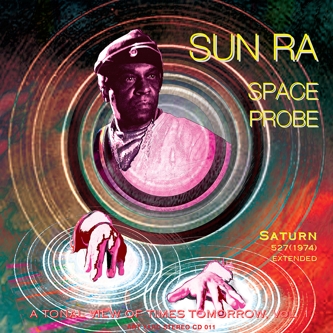
Space Probe dates from 1969-1970, and is a bit of an odd album. "Primitive" starts things out; basically it's a percussion piece featuring James Jacson's log drum and lots of hand percussion. There's just a bit of what sounds like bass clarinet at the beginning, but it doesn't last long. "Conversion of J.P." is a less cacophonous, percussion-oriented piece, highlighted at the beginning by the flute playing of Marshall Allen. Then Ra's piano enters about eight minutes in and takes the tune in a very different direction with the same percussion backing. Ra's playing here is fascinating, though not at all flashy. "Space Probe" is a side-long tour de force by Ra on the miniMoog, and he amply demonstrates that nobody handles a Moog quite like Sun Ra. It could be the sound effects to a '50s sci-fi flick, no problem, or a demonstration of how weird the miniMoog can get. It ain't easy listening, but it's pretty stunning all the same for those with adventurous ears.
:::Review by Sean Westergaard:::

Sun Ra - Space Probe (1978)

1. Space Probe 17:57
2. Earth Primitive Earth 6:12
3. Circe 0:47
4. Solar Symbols II 5:05
5. Dance Of The Wind 2:55
6. Recollections Of There 4:51
7. Destiny 0:54
8. The Conversation Of J.P 13:44

Credits
Clarinet [Bass] – John Gilmore
Drums [Hand] – Nimrod Hunt
Drums [Log Drum] – James Jacson
Flute – Marshall Allen
Synthesizer [Moog], Piano, Other [Intergalactic Instruments] – Sun Ra
Vocals – Thea Barbara

:::Ra #3:::

Posted: Wednesday, 28 September 2011 by jazzlover in Etykiety: , , , ,
2

The Sun Ra Arkestra looks both forwards and backwards in time on this obscure small label LP. Ten years earlier, one could not have imagined Ra and his men romping through "On the Sunny Side of the Street" or reinventing "Flamingo." However, those versions certainly sound quite original, and there is no mistaking the band for any other orchestra on "Space Fling," "Manhattan Cocktail" and the trademark "Space Is the Place." The music on this album features a version of the Arkestra consisting of six reeds (including John Gilmore and Marshall Allen), three trumpets (including Michael Ray and Eddie Gale), two trombones (with a young Robin Eubanks), the French horn of Vincent Chancey, guitarist Dale Williams, three bassists, four percussionists, singer June Tyson and the leader's keyboards. A stimulating set.
:::Review by Scott Yanow:::

Sun Ra - The Other Side of the Sun (1979)

A1 Space Fling 7:37
A2 Flamingo 4:44
Composed By – Anderson, Grouya
A3 Space Is The Place 9:48
B1 The Sunny Side Of The Street
Composed By – J. McHugh 9:35
B2 Manhattan Cocktail 9:54

Credits
Arranged By – Sun Ra
Bass – Ben "Jereeboo" Henderson, Bob Cunningham, OscarBrown, Jr.
Composed By – Sun Ra (tracks: A1, A3, B2)
French Horn – Vincent Chancey
Guitar – Dale Williams
Percussion – Artaukatune, Eddie Thommus, Luqman Ali, William Goffigan
Photography By [Cover] – Jay Edgerton
Piano [Acoustic], Electric Piano [Fender Rhodes], Percussion, Bells, Vocals – Sun Ra
Producer – Sun Ra
Reeds – Danny Davis, Danny Thompson, Elo Omoe, James Jacson, John Gilmore, Marshall Allen
Trombone – Robin Eubanks, Tony Bethel
Trumpet – Eddie Gale, Michael Ray, Walter Miller
Vocals – June Tyson

:::Ra #2:::

Posted: Tuesday, 27 September 2011 by jazzlover in Etykiety: , , , , ,
2

Along with Lanquidity, Nuclear War is one of the rarest discs in Sun Ra's enormous catalog. Recorded in 1982, Nuclear War disappeared until 2001 when the Chicago-based Atavistic label made it part of their exceptional "Unheard Music Series." Originally Ra was so sure the funky dance track was a hit, he immediately took it to Columbia Records, where they immediately rejected it. Why he thought a song with the repeating chant "Nuclear War, they're talking about Nuclear War/It's a motherf***er, don't you know/if they push that button, your ass gotta go/and whatcha gonna do without your ass" would be a hit is another puzzle in the Sun Ra myth. Even with the danceability factor, without heavy censoring, the song would never be played on the radio. Severely depressed by the rejection, but still determined, Ra licensed the track to Y Records, a post-punk label out of Britain. Initially a vinyl 12" was released with "Sometimes I'm Happy" on the flip side. Two years later, Nuclear War was released as an album, but only in Italy. The remaining tracks include four originals and three standards, Ellington's "Drop Me Off in Harlem," "Sometimes I'm Happy," and "Smile." The latter two are highlights in their own right thanks to the gorgeous vocals of June Tyson.
:::Review by Al Campbell:::

Sun Ra - Nuclear War (1982)

1. Nuclear War 7:44
Vocals – June Tyson
2 Retrospect 5:40
3 Drop Me Off In Harlem 5:03
Written-By – Ellington
4 Sometimes I'm Happy 4:27
Vocals – June Tyson
Written-By – Caesar, Youmans
5 Celestial Love 5:30
6 Blue Intensity 5:14
7 Nameless One No. 2 3:59
8 Smile 4:25
Vocals – June Tyson
Written-By – Chaplin

Credits
Alto Saxophone, Flute – Marshall Allen
Baritone Saxophone, Flute – Danny Ray Thompson
Bass – Hayes Burnett
Bassoon, Percussion [Infinity Drum] – James Jacson
Congas, Percussion – Atakatune
Drums – Samarai Celestial
French Horn – Vincent Chancey
Piano, Synthesizer, Organ, Vocals – Sun Ra
Tenor Saxophone – John Gilmore
Trombone, Vocals – Tyron Hill
Trumpet – Walter Miller

:::Ra #1:::

Posted: Monday, 26 September 2011 by jazzlover in Etykiety: ,
3

A hard-to-find, alternately chaotic and tightly organized mid-'70s session that was issued on the Cobra, and then Inner City labels. Sun Ra provided some stunning moments on the Rocksichord, while leading The Arkestra through stomping full-band cuts of atmospheric or alternately hard bop compositions, peeling off various saxophonists for skittering, screaming, at times spacey dialogues.
:::Review by Ron Wynn:::

Sun Ra - Cosmos (1976)

1. The Mystery Of Two 5:47
2. Interstellar Low-Ways 4:45
3. Neo Project #2 5:15
4. Cosmos 2:50
5. Moonship Journey 6:30
6. Journey Among The Stars 5:50
7. Jazz From An Unknown Planet 8:10

Credits
Alto Saxophone, Flute – Danny Davis, Marshall Allen
Baritone Saxophone, Flute – Danny Thompson
Bass Clarinet, Flute – Elo Omoe
Bassoon, Flute – Jac Jackson
Drums – Larry Bright
Electric Bass – R. Anthony Bunn
French Horn – Vincent Chancey
Keyboards [Rocksichord] – Sun Ra
Tenor Saxophone – John Gilmore
Trombone – Craig Harris
Trumpet – Ahmed Abdullah

:::Symbiosis:::

Posted: Sunday, 18 September 2011 by jazzlover in Etykiety:
3

Second full Jazz Q studio album is their top release. It's interesting to notice how fast jazz band, founded in mid-60s became free jazz/experimental band in late 60s and turned to bluesy jazz- rock in early 70-s.
If you ever heard Jazz Q split album with Blue Effect (where they are more free jazz part, balanced with bluesy jazz rock by Blue Effect ), you will be surprised from very first sounds of this album. First of all, band have female vocalist now ( Joan Duggan), and then they play totally different music there.
Joan's vocals are in the key of Nico, with similar timbres, just stronger. Music on this album is keyboards-dominated jazz rock, influenced by Brian Auger, with often jazzy drumming and great Frantiek Francl guitar solos over it. Music is very bluesy, far not so complex and experimental as on band's split debut.
Excellent jazzy musicianship in combination with light psychodelia of Joan's vocals and perfect guitar work bring this album on forefront of similar albums (in fact this release could be placed at the same level with best Auger/Driscoll releases).
Best album of one of the best Czech jazz fusion bands from early 70-s. Very recommended!
:::Review by snobb:::

Jazz Q - Symbiosis (1973)


1. From Dark to Light (6:05)
2. Lost Soul (6:05)
3. Starbird (7:25)
4. The Wizard (16:25)
5. Epilogue (3:25)

Credits
Backing Vocals - Jiř Rotter , Leek Semelka , Pavel Dydovič , Vladimr Mik
Bass - Vladimr Padrůněk
Clarinet - Jan Kubk
Congas - Jiř Tomek
Double Bass - Alexander Čihař
Drums - Michal Vrbovec
Electric Piano, Piano, Organ, Harpsichord, Leader - Martin Kratochvl
Guitar - Frantiek Francl
Lead Vocals - Joan Duggan
Trumpet - Radek Pobořil

:::Weather Report:::

Posted: Wednesday, 14 September 2011 by jazzlover in Etykiety: , , , , ,
4

With two WR members emanating from Miles' Bitches Brew line-up (Zawinul and Shorter), it was obvious that their first album would be heavily influenced by it. But to everyone's surprise, WR's debut only took BB as a starting point and expanded on it, pushing the musical adventure a notch further and improvising so well and inspired, that you'd swear the whole thing is written. The duo enrolled the Czech-born Miroslav Vitous, (which will become an indispensable early WR's pillar) than secured Brazilian-born percussionist Airto Moreira and drummer Alphonse Mouzon, thus creating a real supergroup or an all-star line-up as the jazz circles prefer it. Released in 71 on the Columbia banner with a strange abstract artwork, WR's debut would take the JR scene by storm.
Right from the first twitches of Milky Way, we just know we're in for a long strange trip, as the music flirts with atonalities, then reaching a strange metamorphosed Miles jazz-funk (Umbrellas) that takes away the pleasantness and replacing it with cold hard improvising. On Seventh Arrow (a Vitous track), Zawinul's Fender Rhodes takes us sky-bound with Shorter's sax hovering like a mosquito around our ears until Zawinul derails the train into cosmic heights with his weird synths layers. The album's highlight is the Zawinul-penned Orange Lady, starting out lazily under the noontime sun, and then simply roasting under the scorching sun.
The flipside opens on the magical Morning Lake, with zawinul's Rhodes layering the track as to allow vitous to soar with his bass, while Shorter's sax is the cool breeze setting the mist apart to let the sunrays grace our ears. Waterfall, as you'd guess, is definitely more rapid than the Morning Lake, but obviously the cool Shorter breeze is not yet shaking the night's torpor. Shorter was being short-changed in terms of songwriting credits up to now, but he gets to close the album with two tracks, first the again-slow (but brooding and menacing) Tears (astounding track with celestial voices) and the funkier Eurydice, which is much closer to conventional jazz than the Z-S duo had done in quite a while.
An impeccable album, but not likely suited for everyone as it is much slower than you'd expect a WR album, especially for those more familiar with the Pastorius days. Personally, I always preferred the Vitous-era as they were truly groundbreaking and along with its successor, this album is clearly teir most progressive.
:::Review by Sean Trane:::

Weather Report - Weather Report (1971)

1. Milky Way (2:33)
2. Umbrellas (3:27)
3. Seventh Arrow (5:22)
4. Orange Lady (8:43)
5. Morning Lake (4:25)
6. Waterfall (6:20)
7. Tears (3:25)
8. Eurydice (5:45)

Credits
- Airto Moreira / percussion.
- Alphonze Mouzon / drums, voice
- Wayne Shorter / soprano & tenor saxophones
- Miroslav Vitous / acoustic & electric basses
- Joe Zawinul / acoustic & electric pianos

Additional musicians
- Don Alias / percussion
- Barbara Burton / percussion

:::Give & Take:::

Posted: by jazzlover in Etykiety:
1

Floating Anarchy
Here & Now's debut album is a stunning, if slightly inconsistent effort; when it's good, it kicks serious donkey and ranks up there with the very best space/prog has to offer. You will be hard pushed to find better.
If you're familiar with "Floating Anarchy" (listed under Gong), then you'll have an idea of what you're in for, as this is "The Here and Now Band" referred to on that album. Here & Now mix punk, reggae influences and space rock into a sound reminiscent of Gong and Hawkwind, and it's easy to hear where the Ozric Tentacles got their sound from (the Ozrics regularly supported Here & Now in the early 1980s before their first album release).
The first track is actually entitled "What You See is What You Are" on my original vinyl copy - and on the Here & Now fan sites. A catchy, spacy keyboard hook is joined by a unison female vocal and the bass/drums/guitar pile in with a driving riff for a pair of verses and chorsuses that are pleasant but don't attempt to progress. But the interesting bit is to follow; the instrumental section kicks off into a different dimension - a spine-tingling space bridge that could have been lifted from "You", but with the Here & Now twist; Kieth da Bass driving Kif Kif le Batteur's jazzy percussions under some superb Hillage-esque guitar from Steffi Sharpstrings - we get the feeling that this is something the Ozrics would like to have achieved.
"Nearer Now" is a well-written song with fabulous "walky" bass lines. There seem to be snippets of early Pink Floyd and Hawkwind here. There's a punky edge, and the song is in a fairly standard format - but somehow this is unmistakably prog rock, with the catchy yet unpredictable melody lines, contrapuntal instrumental parts and ambiguity of key base. Around 3:40 the instrumental section kicks in, and Steffi S provides spine-tingling and melodic guitar solo lines treading once more into Steve Hillage's shoes with something that might have come from "Green".
"Grate Fire of London" is the centerpiece for me. An absolute masterpiece in itself and worth the price of the album. Smoky keyboards swirl around ambient guitars as Sooze ba Blooze sings "I'm gonna find you again" in a pure voice - comparisons to Annie Haslam may be appropriate here, but the space whispers are more similar to Shakhti Yoni. Percussion and bass increase the dramatic tension, and we get colours of "Angel's Egg", but with added chaos and sirens. The instrumental section from around 5:02 onwards is peculiarly regressive in some ways, in that it hearkens back to "Flying Teapot" and even "Camembert Electrique", but with Keith's pounding bass lines. Steffi's unison guitars and Kif Kif's precision drumming confirm the "Camembert..." links - but the music does not kick in, leaving anticipation for what happens next...
...which I find somewhat unsatisfying. Keith's bass has a fantastic rich sound, da Blitz works some great spacey keyboards, Sharpstrings provides some really subtle stabbing accompaniment - but the overall effect is of a very repetitive and unimaginative song "This Time". When the change comes it's chaotic - but in a disorganised way. The "stream of consciousness" male vocals are probably the best feature of this track - although I might take issue with the line "If you wanna lot of chocolate on your biscuit join a club..."
"Seventies Youth" is delightfully "Dippy Hippy" and a simply wonderful song. At the same time, it is the foundation of the songwriting path that Here & Now would follow. The albums that come after this, up to "Been and Gone" all develop the style presented in this track - but are very hard to track down. Notable points; It's just a great song with superb textures - not harmonically adventurous, but slightly Bowie in flavour, and very psychedelic.
"Improvisation" is just that. 11 minutes of blissful Here & Now style improv - although you just know that the structure was pre-arranged... H & N demonstrate what it is to play with feeling - this is how it's done, boys and girls, and this would only be out of place on an Ozrics album because it outclasses the Ozrics all over. Otherwise, you might be forgiven for thinking this was the Tentacular ones with Hillage on lead and beautiful and sometimes slightly disturbing female backing vocals. Enjoy this one at maximum volume and dance around your clothes, which are probably in a pile on the floor by now...
But close the curtains, OK ;0)
Easily the proggiest of Here & Now's output of the 1970s and 1980 (the remainder of their albums focus on progressive songwriting, incorporating ever deeper punk and reggae influences), "Give and Take" possesses something of a mysterious otherworldly quality and comes highly recommended, despite the fact that I can't really award masterpiece status, mainly because of "This Time".
:::Review by Certif1ed:::

Here & Now - Give & Take (1978)


1. What You See Is What You Get (5:23)
2. Nearer Now (5:42)
3. Grate Fire Of London (7:33)
4. This Time (4:46)
5. Seventies Youth (5:00)
6. Improvisation (11:04)

Credits
- Steffy Sharpstrings / guitar, vocals
- Keith tha Missile / bass, vocals
- Gavin da Blitz / keyboards, synthesizers
- Kif Kif Le Batter / drums, guitar, vocals
- Suze da Blooze & Annie Mandrake / Choir of Angels

:::Fantasy Of Horses:::

Posted: Monday, 12 September 2011 by jazzlover in Etykiety: ,
2

Wow!! I never start my review with wow. But apparently this group remains to be discovered by a lot of people, and that includes me. Talk about unearthing a gem here. Out of nowhere comes from the underworld this strange band that knows what drama is. As a matter of fact, some of their music can even be called operatic having not only a string section but also a moody wind section as well: jazzy feel on those very Spanish Conquistador dramatic themes. Yes, the music is often grandiose (sometimes bordering on the cheesy) and being somehow what Days Of Future Past should've been. Does this sound intriguing? Ya betcha!! These guys are drawing musical circles around you and they are twiddling with your unstabled brains with their incredible musical meanders and those orgasmic Mellotrons washes. For their second album, leader Browning opted for another horn section, and inside the quartet baritone singer Hoban stepped in to take the keyboards.
I am generally not an opera fan (and certainly do not like the "high culture" snobbery always present at those events), but here I will not only make an exception, we are in for a real rock opera, much more than the great Townsend threw at us into his trips and anguishes (go back to sleep, Rick!!). This music is really classical music fused with rock and might just be on the best example of fusion ever (even if I repeat the word cheesy). But the rock parts are hovering between early Crimson with a great (and much more than that) rhythm section, jazzy Spanish horn section drawing of Rodriguez-type of Aranjuez Concerto. Just flabbergasting if you let yourself taken by the waves of the music. The four tracks (two short and two epics) are gut-wrenching, fascinating, orgasmic, grandiose hair-raising (hear the Farewell of Dancer, the first epic) and yet flow so easily together to form one gigantic track. So much that the heavily rhythmic jazz rock of City Night Life simply does not shock, but actually perfectly and lovingly out-of-place, just like it was meant to be. Too bad for an excellent drum solo that lasted a minute too long, though. The title track starts on a slow operatic style but the crescendo is breathtakingly implacably progressive. Stupendous flutes with the whole orchestra pushing the oboe and other winds (the trombone gets some superb underlines), the whole thing resonates a bit like those unique and crazy Finns of Haikara (their first album really) due to the same Crimson influences but also Magma's works on choral works and interplay with rock. Stupendous, incredibly flawlessly played and written, this is nearing perfection although on the duration, not throughout the whole album, but close enough to be a masterpiece.
Just some 35 minutes-long, this album is easily the best thing to have come from down under, crushing any other pretenders by far, even (especially ;-) Sebastian Hardie. A second reissue saw the light of day in 06 (along with the never re-issued debut The Armada) with a 13-min+ bonus Browning-penned instrumental track Eagle Odyssey, which is not of the same era, recorded purposely for this album's bonus and entirely symphonic (no group or rock instruments). However it fits the album so well, that you don't even notice any difference and most listeners discovering the album now, will most likely integrate it in the album's oeuvre as if it had been there from the start. Sibelius and Strauss come to mind, when listening to this piece.
I'm not exactly sure how I should take the fact that this group was never being exposed (not even sure there are that many collectors who know of the group) and that they are finally getting exposition some 30 years later. This was obviously not a cheap record to make back then, so it is hard to understand how this group was never promoted properly. I just can't believe there are still some incredible albums that are finally getting a bit of attention some 30 years later (but this is also what keeps this old geezer up to his progressive obsessions ;-). Because music like this is only waiting for progheads to love it. One of my shocks this year!!!
:::Review by Sean Trane:::

Rainbow Theatre - Fantasy Of Horses (1976)

1. Rebecca
2. Dancer
.. a) Straicase
.. b) The big time
.. c) Spin
.. d) Theatre
.. e) Farewell
3. Caption for the city night life
4. Fantasy of horses
.. a) Early light
.. b) Frolic
.. c) Trappers
.. d) Captives
.. e) Frolic
.. f) Escape
.. g) Cliff edge

Credits
- Julian Browning / guitar, keyboards
- Ferg McKinnon / bass
- Graeme Carter / drums, percussion
- Keith Hoban / vocals, organ
- Frank Graham / trumpet
- Martin West / saxophone, clarinet
- Ian Relf / trombone
- Tricia Shevenan / flute
- Chris Stock / oboe
- Karin McGechie / violin
- Stephen Daunt / violin
- Nya Murray / violin
- Rowan Thomas / alto
- Sara Glenie / violoncello

:::Jean Louis:::

Posted: Saturday, 10 September 2011 by jazzlover in Etykiety:
4

Jean Louis's self-titled debut merges avant-jazz, math rock and noise into a stylish and highly energetic whole that kicks your ass from start to finish.
This three-piece, consisting of Aymeric Avice on trumpet, Joachim Florent on double bass and Francesco Pastacaldi on drums, creates an enormous sound with their heavy, groove laden melodies and tasteful electronics. The players here are really top-notch musicians and know how to play their respective instruments. The rhythm section likes to play math rock-esque grooves, while the noisy trumpet either joins in, or adds flourishes over the top with the use of a mic and effects pedals. This rhythm section rivals that of any of the great bands from the 70's, magma included and they rock out harder than most so-called rock bands out there. The drumming on this album is some of the best in any genre, but Joachim Florent on bass is really the glue that hold the band together. He is an absolute magician, changing from finger to bow and even thumping his bass with a drum stick on the song Airbus, his constantly shifting rhythms and deep grooves are really impressive to listen to and really brings a cohesiveness to the overall sound of the band.
The album starts off with the track Tourlac and what a start it is! This track really gets the album off to a rolling start with a screeching trumpet flowing into an incessant bass drum that soon gives way to a stop start section with all three instruments playing together. The bass and drums continue of a sick groove while the trumpet goes on a tangent, using electronics that sounds like multiple distorted trumpets all playing in unison. The song then moves into a quiet section with the bass playing a slow, chilled out rhythm while the trumpet adds various electronic flourishes. The track eventually builds and builds back to the original groove with a slight slowing down of tempo here and speeding up there and then winds down into a quiet ending with the trumpet and bass.
Maximator, starts with a somewhat slow and low key groove from the bass and drums which is then rudely interrupted by a howling trumpet that comes in from nowhere and transforms the song into a noisy beast. This is certainly the most aggressive track on the album and moves along quickly like a thrash metal song until its untimely end where the trumpet fades back out into the darkness. The first of the untitled tracks is a minimalist interval that serves the purpose of bringing the tracks together, whether it is successful is up to debate, but it is by no means unpleasant and is over soon enough. It consists of a heartbeat followed by speedy tapping on the cymbals and a moaning, creaking bass in the background.
The third track on the album called Zakir, begins with a serene bass playing by itself and is joined by a marching snare that is then soon accompanied by Aymeric's trumpet that plays in unison with Francesco's drums. The bass soon joins in the march and a siren then sounds announcing the start of an unexpected bass solo where Joachim's groove is embellished with tiny guitar-like effects and ghostly howls from the trumpet. The rest of the band then joins in and they play a wonderful , distorted, mid-paced groove together that eventually evolves into a into a blistering tempo that really makes the heart pump and then back into a quiet section with the bass thumping quietly while the trumpet plays a soft tune. The song ultimately regains its momentum and then ends with a stylish thud.
After another untitled track very similar to the first, the band performs Airbus. This is the real standout track on the album, by means of its incredible groovyness and suberb angular melodies. It launches with a groove (there's that word again!) in which all three instruments participate, and melts into a subdued free jazz-esque section until the Joachim announces the return of the marvelous math rocky rhythm that dominates much of the song with the pounding of a drumstick on his stand up bass. They continue of this super sweet groove until the trumpet plays a kind of rolling circular pattern where the music comes into a sort of free-jazz section. The drums play and the bass pulses as they build into a running start as the trumpet screams over top of them, shouting into the mic. The swinging groove returns and becomes faster and ever faster and frantically runs to the finish line, ending in a noisy mess of muddled sound.
Tranche is another terrific track that blends heavy riffs and intense jazz into a wonderful combination. The beginning is a heap of different sounds floating in and out as the bass is bowed in a steady fashion. The track progresses to a pulsating rhythm and gets really cooking about midway through, where the trumpet pumps out more guitar riffs and the the drummer constantly pounds on the snares. This song is Aymeric's finest as his trumpet soars above the constantly shifting backing rhythms.
Chasseurs En Transe is started with the marching of the snare drum and the track is set in motion by a constantly thumping bass drum. The song rolls along at a good pace with the horn screeching and wailing all over the place. This section is a real thumper that moves into one of the most swinginest sections on the album before making room for one of the free jazz-like parts of it. The track ends with the return of the original melody and a bass that fades out.
Another untitled and then the finale of the album, a song called Kasams. A song that starts with several loud bangs that shifts into a rapid tempo. The bass throbs and the trumpet plays, sounding like many, as the song then dissolves into a pulsating bass where the drums cease and eerie noises creep in and out. The tune builds back up and the drums return with a flurry of notes and beats that takes the tune to even greater heights. The band continues on a scorching pace, deconstructs it, only to build it back up again. They conclude it with a huge breakdown, a few minutes of silence, a solo trumpet and then a bass solo as an afterthought to thank the listener.
Jean Louis's debut is nothing short of spectacular and is one of the finest RIO/Avant-prog albums to be found anywhere. The band is definitely not one to be missed, with their great interplay and undeniably weighty grooves and will appeal to jazz, noise, and math rock fans. This album is an absolutely essential one for any serious collector of avant-garde music and to any prog fan in general.
:::Review by Evolutionary Sleeper:::

Jean Louis - Jean Louis (2008)

1. Tourlac (6:57)
2. Maximator (2:31)
3. ... (1:10)
4. Zakir (9:31)
5. ... (0:50)
6. Airbus (7:00)
7. Tranche (6:17)
8. Chasseurs En Transe (5:44)
9. ... (0:43)
10. Kasams (8:45)

Credits
- Aymeric Avice / trumpet
- Joachim Florent / double bass
- Francesco Pastacaldi / drums