
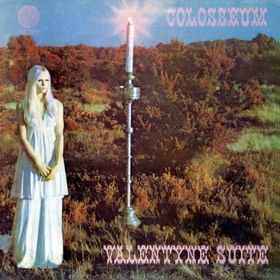
:::Valentyne Suite:::

Posted: Saturday, 18 April 2009 by jazzlover in Etykiety:
2


I was completely blown away by this album. Especially since I never warmed-up to their following effort, "Daughter of Time". "Valentyne Suite" was their second and final album with the original lineup of keyboardist Dave Greenslade, bassist Tony Reeves, guitarist/vocalist James Litherland, drummer Jon Hiseman, and saxist Dick Heckstall-Smith. Reeves and Litherland would be the ones to defect from the band after this album.
"Valentyne Suite" was the very first album ever released on the "swirl" Vertigo label (if you own the version on Bronze Records, you have the reissue, which was issued after the band made the move to that label in '71). Without a doubt, this is by far the most interesting John Mayall-related album I have ever heard (Heckstall-Smith and Reeves had played in Mayall's Bluesbreakers). "The Kettle" is a rather rocking number, dominated by heavy use of guitar. "Elegy" is a rather jazzy piece complete with strings. Great piece. "Butty's Blues" is, as you expect, a bluesy-piece, but you get lots of CHICAGO or BLOOD, SWEAT & TEARS-like horns. "The Machine Demands a Sacrifice" is more hard rocking, blues-influenced number then unexpectedly (at the end) finds the band doing a bizarre experiment that reminds one of Krautrock bands that would appear in the next couple of years. The album closes with the totally amazing title track, divided in to three movements. This is basically Dave Greenslade's time to shine. The music is just unbelievably intense, and you should check out Jon Hiseman's drumming! I can hardly believe it! Amazing album, and for those who don't mind jazz and blues in their prog rock, you should get this album.
:::Review by Proghead:::

Colosseum - Valentyne Suite (1969)

1. The Kettle (4:25)
2. Elegy (3:10)
3. Butty's Blues (6:44)
4. The Machine Demands A Sacrifice (3:52)
5. The Valentyne Suite:
Theme One: January's Search (6:25)
Theme Two: February's Valentyne (3:33)
Theme Three: The Grass Is Always Greener (6:55)


Musicians
- Dave Greenslade / Organ, Vocals
- Dick Heckstall-Smith / Sax
- John Hiseman / Drums
- Tony Reeves / bass
- James Litherland / guitar, vocals

:::Air Lore:::

Posted: Thursday, 16 April 2009 by jazzlover in Etykiety: , , ,
5


Recorded for RCA in 1979, the vanguard trio Air set out to explore its jazz roots. In fact, not only the trio's jazz roots, but everybody's right back to Scott Joplin and Jelly Roll Morton as they were inventing a music that would tear up the streets of New Orleans and later change the world. Interestingly, since most of the music here -- all written by the aforementioned except for one tune -- was composed by pianists and is widely regarded as piano music, Air's exploration entirely struck the piano from the conversation. Reedman Henry Threadgill, bassist Fred Hopkins, and drummer Steve McCall turned the ragtime music of the fathers inside out and created an exploratory reinsertion of it into the avant-garde of the late '70s. Jelly Roll's "Buddy Bolden's Blues" becomes a blues from another century in the melodic universe of Threadgill, who doesn't give a damn about changes as much as he does stretching the harmonics of the blues idiom into other musics entirely. And in the familiar "King Porter Stomp," also by Morton, Threadgill challenges McCall, who quadruples the time so Henry and Fred can stop up the middle eight with some weird angular intervals where arpeggiated harmony and modal striation become one and the same thing. Finally, on Joplin's "Weeping Willow Rag," the band moves through the changes and then undermines them, turning them inside out as if this were really a party tune from somewhere that willow trees didn't exist or had already disappeared into some toxic twilight. Here are the joyous blues, the raucous blues, the rip 'em up and then send 'em home blues trapped in a color palette so rich and so varied it's difficult to find only one or two textures to fit them inside. Through it all, this remains the album most Air fans love most, precisely because of all the joy and irreverence in the proceedings, which didn't update the old music, but brought it into focus for the revolutionary improvisational template that it is.
:::Review by Thom Jurek:::

Air - Air Lore (1979)

1. The Ragtime Dance (9:20)
2. Buddy Bolden's Blues (9:30)
3. King Porter Stomp (3:52)
4. Paille Street (2:20)
5. Weeping Willow Rag (11:31)

Credits
Bass - Fred Hopkins
Drums, Percussion - Steve McCall
Producer - Michael Cuscuna
Saxophone [Tenor, Alto], Flute - Henry Threadgill

:::Word Of Mouth Revisited:::

Posted: Wednesday, 15 April 2009 by jazzlover in Etykiety:
2


Back before he turned everyone's idea of bass playing inside out, Jaco Pastorius spent five years on the bandstand with the Peter Graves Orchestra at Bachelors III, a swanky spot in his hometown of Ft. Lauderdale. Nearly three decades after the future star's departure in 1975, and 16 years after his brutal murder, Graves got the guys back together, christened them in their former colleague's name, and invited the most prominent bass guitarists of the early 21st century down to join them in a project dedicated to Pastorius' legacy. Throughout these polished performances, the bass parts testify to how profoundly Pastorius altered that instrument's role. Bottom line (so to speak): he gave them the option of playing from a soloist mentality and blowing all over the beat, as fast and free as any saxophonist, as long as he or she had chops and didn't subvert the groove. The guest bassists on this collection absorbed this lesson long ago. Each can scatter quick licks, some of them even faster than Pastorius himself. So why does a vague disenchantment haunt these performances?
Perhaps it's because these players, great as they are, are still emulating more than discovering. Some imitate even the nuances of the Pastorius tone and phrasing, as does Richard Bona on "Punk Jazz" -- which, of course, may be a form of tribute in this context. On an opposite extreme, the light-speed, staccato hailstorm unleashed by Victor Wooten on "Teen Town" is fundamentally unmusical, focusing on the player more than the material being played -- which is, come to think of it, the real revelation here. Pastorius' tunes reflect a compositional maturity that wasn't always evident in the more improvisational context of Weather Report, and his arrangements -- notably an idiosyncratic treatment of "Killing Me Softly" and the marimba-flavored exotica of "Opus Pocus" - suggest that had he had more time, he would have written history with his pen as much as his performance. One complaint: the samples of Pastorius' voice, chopped into microbits that carry no meaningful content and seem intended to function as objects of postmodern reflection, if not reverence. All these interruptions accomplish is to remind you that some artists speak most eloquently without words.
:::Review by Robert L. Doerschuk:::

Jaco Pastorius Big Band - Word Of Mouth Revisited (2003)

1. Jaco Speaks (0:07)
2. Jaco Pastorius Big Band Havona (5:20)
Arranged By - Larry Warrilow
Bass - Jimmy Haslip
Written-By - Jaco Pastorius
3. Jaco Pastorius Big Band Teen Town (4:11)
Arranged By - Larry Warrilow
Bass - Victor Wooten
Written-By - Jaco Pastorius
4. Jaco Speaks (0:04)
5. Jaco Pastorius Big Band Punk Jazz (5:04)
Bass - Richard Bona
Saxophone [Tenor] - Mike Scaglione
Written-By, Arranged By - Jaco Pastorius
6. Jaco Speaks (0:05)
7. Jaco Pastorius Big Band Barbary Coast (5:54)
Arranged By - Larry Warrilow
Bass - Gerald Veasley
Written-By - Jaco Pastorius
8. Jaco Pastorius Big Band Killing Me Softly (4:23)
Arranged By - Jaco Pastorius
Bass - Jeff Carswell
Written-By - Charles Fox , Norman Gimbel
9. Jaco Speaks (0:05)
10. Jaco Pastorius Big Band (Used To Be A) Cha Cha (6:54)
Arranged By - Dan Bonsanti
Bass - Victor Bailey
Written-By - Jaco Pastorius
11. Jaco Pastorius Big Band Wiggle Waggle (5:47)
Arranged By - Stan Webb
Bass - Jaco Pastorius
Written-By - Herbie Hancock
12. Jaco Speaks (0:11)
13. Jaco Pastorius Big Band Continuum (3:22)
Bass - Jimmy Haslip
Written-By, Arranged By - Jaco Pastorius
14. Jaco Speaks (0:04)
15. Jaco Pastorius Big Band Elegant People (6:30)
Arranged By - Jaco Pastorius
Bass - Gerald Veasley
Percussion [Hand Drums] - Bobby Thomas Jr.
Written-By - Wayne Shorter
16. Jaco Pastorius Big Band Opus Pocus (5:15)
Arranged By - Larry Warrilow
Bass - David Pastorius
Marimba - Gary Mayone
Written-By - Jaco Pastorius
17. Peter & Jaco Speaks (0:47)
18. Jaco Pastorius Big Band Domingo (6:45)
Bass - Victor Bailey
Written-By, Arranged By - Jaco Pastorius
19. Jaco Pastorius Big Band Forgotten Love (4:02)
Arranged By - Larry Warrilow
Bass - Christian McBride
Flute - Mike Scaglione
Written-By - Jaco Pastorius
20. Jaco Speaks (0:04)
21. Marcus Miller Punk Jazz Revisited (6:35)
Bass, Clarinet [Bass], Drums, Clavinet, Saxophone [Soprano], Scratches - Marcus Miller
Saxophone [Soprano] - Roger Byman
Trumpet - Michael "Patches" Stewart
Written-By - Jaco Pastorius , Marcus Miller

Credits
Conductor - Peter Graves
Drums - Mark Griffith (2)
Guitar, Koto [Synth] - Randy Bernsen
Piano, Keyboards - Michael Levine
Saxophone [Alto, Soprano], Flute, Flute [Piccolo] - Billy Ross
Saxophone [Baritone], Clarinet [Bass], Flute - Mike Brignola
Saxophone [Tenor, Alto], Clarinet, Flute - Gary Keller
Saxophone [Tenor, Soprano], Clarinet - Ed Calle
Trombone - Dana Teboe
Trombone [Bass] - Craig Gosnell (tracks: 5, 10, 18) , John Kricker
Trumpet, Flugelhorn - Jason Carder , Jeff Kievit , Ken Faulk

:::Čikori:::

Posted: Tuesday, 14 April 2009 by jazzlover in Etykiety:
1


Iva Bittová does not release albums very often, making each one something to treasure. Cikori is her first major project since her critically acclaimed duet with Vladimír Václavek, the 1997 Bilé Inferno, and her first group effort since she left Dunaj. Cikori is actually both the title of the album and the name of this quintet, which is also comprised of Václavek (acoustic guitar), Frantisek Kucera (trumpet), Jaromír Honzák (double bass), and Milos Dvorácek (drums and percussion). The three new players already appeared as guests on selected tracks from Bilé Inferno. Basically, this opus develops more elaborate arrangements around the sound of the previous album. Václavek remains an essential part of the atmosphere, but the added instruments provide a wider palette for the singer. Songs like "Krídla" and "Zapísej" show the same attention to melodies, sparse arrangements, delicate build-ups, and charm. In "Jungle" and "První," the group adopts a quasi-Latin mood, which gives Bittová's very personal scats a new color. And who could resist her mischievous child tone when she meows in "Kocha"? Cikori may not be as gripping as Bilé Inferno, but it still represents a strong effort. It's full of beautiful, light, playful pop with an avant-garde twist. Recommended.
:::Review by François Couture:::

Iva Bittová – Čikori (2001)

1. Kočka
2. Mravenčí
3. Křídla
4. Jungle
5. Přání
6. První
7. Polykaka Nožů
8. Zapískej
9. Kazu

Credits
Vladimír Václavek - acoustic guitar
Frantisek Kucera – trumpet
Jaromír Honzák - double bass
Milos Dvorácek - drums and percussion

:::Balladyna:::

Posted: Friday, 10 April 2009 by jazzlover in Etykiety: , , ,
3


Stanko's first recording for the ECM label; it would be twenty years until the next! "First Song" is characterized by a meter that constantly, subtly shifts.
Holland and Vesala blaze as the anchors, but this essentially themeless music is held together by an audible structure that allows Stanko and Szukalski infinite freedom yet never devolves into mere blowing. This track is a wonderful example of how Stanko makes sense by allusion yet sounds free. "Balladyna" starts out as what sounds like a folk melody and mutates in a freeform exploration of pure sound and rhythm. Marvelous!
:::Review by Budd Kopman:::

Tomasz Stańko - Balladyna (1976)

1. First Song (7:38)
2. Tale (3:28)
3. Num (7:11)
4. Duet (2:55)
5. Balladyna (7:59)
6. Last Song (6:02)
7. Nenaliina (5:29)

Credits
Bass - Dave Holland
Drums - Edward Vesala
Producer - Manfred Eicher
Tenor And Soprano Saxophone - Tomasz Szukalski
Trumpet - Tomasz Stańko

:::Afro-Cuban Jazz Moods:::

Posted: Tuesday, 7 April 2009 by jazzlover in Etykiety: , , ,
5


Here we have a summit meeting late in the careers of the pioneering titans of Afro-Cuban jazz -- Dizzy Gillespie fronting the Machito orchestra on trumpet, with Mario Bauza as music director, alto saxophonist/clarinetist, and organizing force, and Chico O'Farrill contributing the compositions and arrangements. This could have been just a nostalgic retro gathering 25 years after the fact, but instead, these guys put forth an ambitious effort to push the boundaries of the idiom. The centerpiece is a 15-minute trumpet concerto for Dizzy called "Oro, Incienso Y Mirra," where O'Farrill melts dissonant clusters, electric piano comping, and synthesizer decorations together with hot Afro-Cuban rhythms into a coherent, multi-sectioned tour de force. Dizzy, who apparently had never been in the same room with synthesizers before, is magnificent as he peels off one patented bebop run after another over Machito's band and in the gaps between. There is also an equally sophisticated suite of O'Farrill pieces grouped under the title "Three Afro-Cuban Jazz Moods," which mixes rock elements into the rhythms. Parts of "Pensativo" sound as if O'Farrill had been carefully listening to Santana, the teacher learning from the student, as it were. It adds up to a paltry 32 minutes of music, yet one can forgive the short weight, this being all there is of a historic recording session.
:::Review by Richard S. Ginell:::

Dizzy Gillespie - Afro-Cuban Jazz Moods (1975)

1. Oro, Incienso Y Mirra (15:39)
2. Calidoscopico (5:09)
3. Pensativo (5:25)
4. Exuberante (5:45)

Credits
Bass [Fender] - Carlos Castillo
Bongos, Cowbell - Mario Grillo
Conductor, Arranged By - Chico O'Farrill
Congas - Pepin Pepin
Drums - Mickey Roker
Drums [African] - Julito Collazo , R. Hernandez
French Horn - Brooks Tillotson , Don Corrado (track: 1 only)
Leader - Machito
Maracas, Claves - Frank "Machito" Grillo
Piano [Electric] - Jorge Dalto
Producer - Arturo O'Farrill , Mario Bauza
Saxophone [Alto], Clarinet - Mario Bauza
Saxophone [Alto], Flute, Piccolo Flute - Mauricio Smith
Saxophone [Baritone], Clarinet [Bass] - Leslie Yahonikan (tracks: 2-4 only)
Saxophone [Tenor], Clarinet - Jose Madera Sr.
Saxophone [Tenor], Flute [Alto] - Mario Rivera (2)
Soloist - Dizzy Gillespie
Synthesizer - Dana McCurdy
Timbales, Cabasa - Jose Madera Jr.
Trombone - Barry Morrow , Jack Jeffers , Jerry Chamberlain (tracks: 2-4 only) , Lewis Kahn (tracks: 2-4 only)
Trumpet, Flugelhorn - Manny Duran , Ramon Gonzalez Jr. , Raul Gonzalez (4) , Victor Paz
Tuba [Bass] - Bob Stewart (track: 1 only)

:::Execution Ground:::

Posted: Saturday, 4 April 2009 by jazzlover in Etykiety: , , ,
2


A trio consisting of alto saxophonist John Zorn, bassist Bill Laswell,and drummer Mick Harris, Painkiller was a novel blend of free improv, jazz, dub, and death metal. Although the lineup occasionally expanded to include the uniquely gifted Japanese vocalist Yamantaka Eye and other guests, Execution Ground is an investigation of the power and range of the core trio. The first disc of this inventive and unsettling two-disc set features three long improvisations that show off the band's dub influence. The second disc, subtitled "Ambient Dub," is a rethinking/remix of the third and first improvs on the first disc. Overall less thrashy than some Painkiller excursions, the improvisations here are striking for their greater sonic space without sacrificing any of the heaviness. At times, the band rests, making way for ominous breathing and distant sustained screams, which recur throughout. The transitions from silence to groove to noise and back are relentless and dramatic. Harris proves to be an astonishingly inventive drummer, consistently varying the foundation in surprising ways. Laswell's tone varies from the brightness of flanged round-wound strings scraping the frets to a clean, menacing low-frequency pulse, and sticks mostly to elemental, non-flashy lines that keep the mood deep and dark. Zorn's playing is excellent here, varying between extremely overblown piercing tones (perhaps the best way of being heard over such a rhythm section) and nearly conventional jazzy lines that confidently ride atop the din. An occasional microtonal chorus effect warps his playing, and the effect is so disturbing that it's surprising he soon abandoned this technique.
:::Review by Maurice Rickard:::

Painkiller - Execution Ground (1994)

Execution Ground
1-01. Parish Of Tama (Ossuary Dub) (16:05)
1-02. Morning Of Balachaturdasi (14:45)
1-03. Pashupatinath (13:47)
Ambient
2-01. Pashupatinath Ambient (20:00)
2-02. Parish Of Tama Ambient (19:19)

Credits
Artwork By [Layout, Design] - Studio T.
Bass, Samples - Bill Laswell
Drums, Samples, Vocals - Mick Harris
Engineer - Oz Fritz (tracks: 1-01 to 1-03) , Robert Musso (tracks: 2-01, 2-02)
Saxophone, Vocals - John Zorn

:::Queen Of All Ears:::

Posted: Thursday, 2 April 2009 by jazzlover in Etykiety:
3


John Lurie's so-called "non-jazz" approach is in full flower on this fascinating record. The ever-growing (nine-piece at this point) band builds layers of rhythm and melody with unique effect throughout. On "The Birds Near Her House," a serpentine melodic line weaves through a steady rhythmic bed, building to a frenetic climax. "Scary Children" is a foreboding dirge that still manages to exude true humor. Perhaps that is the most significant aspect of this music: it has real character and life. It doesn't just groove -- it starts a conversation.
:::Review by Tim Sheridan:::

The Lounge Lizards - Queen Of All Ears (1998)

1. First and Royal Queen 3:59
2. Birds Near Her House 11:40
3. Scary Children 4:07
4. She Drove Me Mad 4:21
5. Queen of All Ears 5:25
6. Monsters over Bangkok 10:13
7. Three Crowns of Wood 4:01
8. John Zorn's S&M Circus 6:13
9. Yak 5:41
10. Queen Reprise 3:46

Credits
Artwork By [Cover Painting] - John Lurie
Bass - Erik Sanko
Cello - Jane Scarpantoni
Clarinet [Bass] - Michael Blake
Drums - Calvin Weston
Guitar - David Tronzo
Mastered By - UE Nastasi
Mixed By - Pat Dillett*
Organ - Evan Lurie
Percussion - Ben Perowsky
Piano - Evan Lurie
Producer - John Lurie , Pat Dillett*
Recorded By - James Farber
Saxophone [Alto] - John Lurie
Saxophone [Tenor] - John Lurie , Michael Blake
Trumpet - Steven Bernstein
Written-By - John Lurie

:::Ask the Ages:::

Posted: Friday, 27 March 2009 by jazzlover in Etykiety: , , ,
2


Although Charlie Christian introduced the electric guitar to jazz in 1939, everyone playing the instrument in jazz kept his sound and ideas embodied in their playing until the late '60s. During this period the instrument became a vital part of the emerging fusion scene. Some of the electric guitar's most memorable work has come from a handful of rock guitarists who embraced jazz, like Frank Zappa on Hot Rats or Jeff Beck on Blow by Blow. But overall, some of the instrument's finest modern sounds flowed from the fingertips of jazzier players like John McLaughlin. Though each of these artists has had an absolute and immeasurable influence on jazz, the one man who really reinvented the jazz guitar from inside is a player who is barely known outside - or inside - of jazz circles: Sonny Sharrock.
Sharrock (1940-1994) is an interesting piece of the jazz puzzle. He was the first and for the longest time the only guitarist working in the area of free jazz. Though his day job in the late '60s was playing in Herbie Mann's band, his work with Pharoah Sanders, notably on Tauhid, found him really cutting loose, showing a certain genius for creating sound sheets of blistering noise with bop-styled runs. At this point in his life, Sharrock used feedback to duplicate the rips from the brass men he played with, before Jimi Hendrix and Pete Townsend would make it fashionable in the mainstream. His early records as a leader are solid, but he really came together in the '80s when, surprisingly enough the players who were influenced by him began to be noticed in the downtown New York scene. The unaccompanied Guitar (1986) and Seize the Rainbow (1987) were shocking in their unabashed genius, but his last record, Ask the Ages, is unquestionably the greatest achievement of his entire career.
Teaming back up with Sanders, Sharrock does not waste a single note on this record. He summons both his forward sonic attack and a beautifully melodic side with equal ease. Sonny also leads this band with his best compositions ever laid to wax. Working within a variety of time signatures and dropping in riffs that work against the grain of the melody, he maintains a high interest level. Certainly the recording represents a change from what even the most intricate jazz players of the time were doing. He takes nods from Coltrane's modal work and provides a solid and eclectic base.
From the opening run in "Promises Kept," Sharrock builds a fusion-esque groove with drummer Elvin Jones and bassist Charnett Moffett, allowing Sanders to churn out some his strongest playing since the '70s. With the tracks "Little rock" and "As We Used to Sing," the record can almost be seen as a single composition broken into six parts in much the same way as Miles Davis' early-'70s work. These two tracks are the centerpiece and are taken from the same single jam. This makes the whole of the record just as interesting as the individuality of each track. Though they are each unique compositions, after playing the disc through a few times it seems evident that there is a central concept being executed.
One of the highlights on this record is the return of Pharoah Sanders to some of his finest playing in years. Whatever the reason for the renewed enthusiasm, it shows itself throughout. Not only is his playing hot, but there is a true spiritual vibe to his choice of notes and riffs, recalling his classic Impulse work. Sanders' freedom to work outside the perimeter while building up bulk mass fits perfect into the individuality of each tune. The reunion of these two free greats seems to have reenergized their sound, making this recording feel that much more special, especially since it was the last one before Sharrock's death.
The other huge input on this record comes from the man behind the scenes of Sharrock's rise in popularity from the mid-'80s onward: Bill Laswell. Laswell's work on multi-tracking helps to add depth and groove the CD. Laswell is one of the most eclectic voices in music. From the underground noise blasts of his work with Sharrock in Last Exit to his remixes of early rap and dub, he has turned his hand to any number of genres and build a solid vibe. His playing and producing plays as much a role of the final output as Teo Macero's work did with Bitches Brew.
Though Ask the Ages may not be the easiest for jazz guitar fans to get into at first, it is extremely rewarding. Throughout the record Sharrock utilizes a variety of sounds and pushes the limits of his playing. The band certainly picks on the vibe and rips the guts the free jazz's ideas and sound while simultaneously pulling right toward Sharrock's jazz roots.
Spending time in the Sharrock world will certainly help newer jazz fans to understand where players like Bill Frisell, Derek Bailey, and Fred Frith are coming from. Sharrock is without a doubt the brightest beacon of early avant-garde jazz guitar. Running across his records is a schematic that NY downtown guitarists are still using. Certainly the experimental forays of records by Frisell and Frith carry on ideology that Sharrock brought using the guitar as the weapon of means. While most players were spending their woodshedding time learning Wes Montgomery licks, Sonny Sharrock was opening up the jazz guitar to a new world of endless possibility.
:::Review by Trevor MacLaren:::

Sonny Sharrock - Ask the Ages (1991)

1. Promises Kept 9:44
2. Who Does She Hope to Be? 4:41
3. Little Rock 6:35
4. As We Used to Sing 7:32
5. Many Mansions 9:31
6. Once Upon a Time 6:30

Personnel
Sonny Sharrock - Guitar;
Pharoah Sanders - Sax;
Elvin Jones - Drums;
Charnett Moffett - Bass

:::Sky Dive:::

Posted: Wednesday, 18 March 2009 by jazzlover in Etykiety: , , , , , ,
2


Freddie Hubbard's fourth CTI recording (and the second one with Don Sebesky arrangements) certainly has a diverse repertoire. In addition to his originals "Povo" and "Sky Dive" (both of which are superior jam tunes), the trumpeter stretches out on the theme from The Godfather and Bix Beiderbecke's "In a Mist." The charts for the brass and woodwinds are colorful; there is a fine supporting cast that includes guitarist George Benson, Keith Jarrett on keyboards, and flutist Hubert Laws; and Hubbard takes several outstanding trumpet solos.
:::Review by Scott Yanow:::

Freddie Hubbard - Sky Dive (1972)

1. Povo (12:33)
2. In A Mist (7:04)
3. The Godfather (7:21)
4. Sky Dive (7:40)

Credits
Arranged By - Don Sebesky
Bass - Ron Carter
Clarinet - George Marge , Romeo Penque
Clarinet [Bass] - Phil Bodner
Conductor - Don Sebesky
Drums - Billy Cobham
Engineer - Rudy Van Gelder
Flugelhorn - Marvin Stamm
Flute - Hubert Laws
Flute [Alto] - Hubert Laws , Romeo Penque
Flute [Bass] - Hubert Laws
Guitar - George Benson
Oboe - Romeo Penque
Percussion - Airto , Ray Barretto
Piano - Keith Jarrett
Piano [Electric] - Keith Jarrett
Producer - Creed Taylor
Trombone - Garnett Brown , Wayne Andre
Trombone [Bass] - Paul Faulise
Trumpet - Alan Rubin , Freddie Hubbard
Tuba - Tony Price

:::Baselines:::

Posted: Friday, 13 March 2009 by jazzlover in Etykiety: , ,
1


Even though Bill Laswell was already immersed in numerous projects since the end of the '70s, including leading his loose ensemble Material, he didn't release a solo record until 1984, and Baselines was quite a strange album. On the one hand, there's "Upright Man," one of the most infectious grooves Laswell has ever conceived, boasting ace bass playing and a weird taped sermon as sort-of lead vocals. Then there's "Work Song," which is funky and catchy and features Phillip Wilson's somewhat off-beat drumming (pun intended). The other tracks are more experimental, weird, and don't catch on as well -- although they all reward repeated listening, for at first the listener might get lost between Ronald Shannon Jackson's irate drumming, Michael Beinhorn's acid-drenched synths and snippets of tapes and shortwave, the stuttering horns of George Lewis and Ralph Carney, the undescribable contributions of Fred Frith, and the vocalisms and percussion (rhythmic and non-rhythmic) David Moss provides. It's an interesting record, but it's not essential listening, and beginners or fans of Laswell's less avant-garde music won't get much out of this. If the somewhat comparable Memory Serves by Material left you craving more, you might want to give this album a try.
:::Review by Chris Genzel:::

Bill Laswell – Baselines (1984)

1. Activate (3:22)
2. Work Song (7:13)
3. Hindsight (3:57)
4. Uprising (1:05)
5. Barricade (4:06)
6. Upright Man (3:51)
7. Moving Target (1:52)
8. Lowlands (4:22)
9. Conversation (3:05)

Credits
Artwork By - Felipe Orrego , Thi-Linh Le
Bass [Music Man Sting Ray, Fender 6-string, Ibanez 8-string, Steinberger, Fender Fretless Precision] - Bill Laswell
Congas - Daniel Ponce (tracks: 2, 3, 6, 8)
Drums - Phillip Wilson (tracks: 2) , Ronald Shannon Jackson (tracks: 1, 4 to 6, 8, 9)
Drums, Percussion - Martin Bisi (tracks: 3, 6, 7)
Guitar, Violin, Performer [Steinberger String Console] - Fred Frith (tracks: 4, 5, 8, 9)
Mastered By - Howie Weinberg
Producer - Material
Recorded By - Martin Bisi
Saxophone - Ralph Carney (tracks: 1, 2, 5)
Synthesizer, Performer [Shortwave], Tape - Michael Beinhorn (tracks: 1, 2, 4 to 6, 8, 9)
Trombone - George Lewis (tracks: 1, 2, 5, 8)
Voice, Percussion [Non Metric], Drums [Steel] - David Moss (tracks: 3, 9)

:::Destroy All Music:::

Posted: Tuesday, 3 March 2009 by jazzlover in Etykiety:
3


Still as uncompromising as it was at its release almost ten years ago, The Flying Luttenbachers Destroy All Music Revisited is an amalgamation of so many disparate styles of music that it continues to remain virtually unclassifiable. Formed by percussionist and Hal Russell protA©gA© Weasel Walter in 1994, the group went through numerous personnel changes before arriving at the one that would record this, the group's best conceived and must successful effort.
The album features a line-up that pulled from all corners of the experimental Chicago music scene of the 1990s. Joining Walter is saxophonist Chad Organ (who doubles on Moog synthesizer), reedist and free jazz staple Ken Vandermark (who served as Walter's co-leader as a member of the group), trombonist, bassist and Vandermark 5 member Jeb Bishop, and guitarist Dylan Posa. This unique combination of jazz virtuosity and punk rock aestheticism tore apart the walls between No Wave, noise, metal and jazz to create a sound not unlike saxophonist Peter Brotzmann's Last Exit, though The Flying Luttenbachers may be even more relentless and jugular.
The album opens with the grinding "Demonic Velocities/20,000,000 Volts," whose initial single-note saxophone line leads the way into a percussive onslaught of stop-start rhythms, manic genre switches, and all-out chaos. The chaos continues with "Fist Through Glass," which may have even more punk influence. This is an adrenalin releasing mess, complete with thrash guitars, driving drums, and horns that sound more suited to demolition than music.
The original release signaled a regrouping of the ensemble, and consisted of tracks recorded in the studio, live, and in Walter's garage. The noisy freak-out of "(In Progress)" is an improvised piece recorded to 4-track cassette in a shed behind Walter's apartment, while "Tiamat en Arc" is pulled from a live show. The latter features an opening not dissimilar to the deranged lounge that John Zorn's Naked City treads into, but the sudden instrumental break quickly disavows any allegiances this group has to genre.
The original album closed with "Final Variation on a Theme Entitled 'Attack Sequence,'" a piece the group had already released in various manifestations four times. This particular version contains the broken fragments of speed metal, downtown experimental and, of course, jazz, leaving all of them scorched and smoldering on the floor by the end.
The reissue appends seven tracks, six of which are live performances. All of these add further depth to a recording already unmatched in its relentless destruction of musical conformity. Destroy All Music Revisited still fulfills its title's mission statement, and is an important reminder of a group that, despite its under-recognition, is perhaps more relevant than ever.
:::Review by Henry Smith:::

The Flying Luttenbachers - Destroy All Music (1995)

1. Demonic Velocities / 20,000,000 Volts 3:48
2. Fist Through Glass 3:26
3. Sparrow's Thin Lot 1:32
4. Splürge 5:26
5. (In Progress) 3:34
6. Ver aus den 'Turbo Scratcher' 5:38
7. The Necessary Impossibility of Determinism 4:43
8. Dance of the Lonely Hyenas 4:30
9. Tiamat En Arc 3:46
10. Final Variation on a Theme Entitled "Attack Sequence" 2:53

Credits
Bass, Trombone, Keyboards [Casio] - Jeb Bishop
Drums - Weasel Walter
Guitar [Electric] - Dylan Posa
Producer - Flying Luttenbachers, The
Saxophone [Tenor], Clarinet [Bass], Clarinet [B Flat] - Ken Vandermark
Saxophone [Tenor], Saxophone [Baritone], Synthesizer [Moog] - Chad Organ

:::The Jazz Composer's Orchestra:::

Posted: Friday, 20 February 2009 by jazzlover in Etykiety: , , , , , , , , , ,
5


German-born composer/trumpeter Michael Mantler and his then-wife Carla Bley were instrumental in developing within jazz the idea of self-sufficiency and independence from established record companies. Their creation of the Jazz Composer's Orchestra, with recordings released on their own label, was the culmination of this endeavor, and the first recording was one of the masterpieces of creative music in the '60s. Mantler had come from the European avant-classical tradition and sought to provide an orchestral framework supporting some of the most advanced musicians in avant-garde jazz -- and he succeeded magnificently. His style tends toward the brooding and darkly romantic with harsh, cynical edges, a perfect foil for the robust, shackle-breaking improvisations found herein. The cloudy, roiling swirls that open "Communications #8," echoed by Bley's stabbing piano chords, lay the groundwork for inspired soloing by Don Cherry and the pre-Last Tango and still extremely fiery Gato Barbieri. Subsequent pieces include an amazing feedback showcase for Larry Coryell and a gorgeous, somber work featuring bassist Steve Swallow and trombonist Roswell Rudd. All of this is a preview for, well, "Preview," an utterly incendiary flight by Pharoah Sanders over a pounding rhythm by the orchestra, a piece that will leave the listener bruised, battered, and exhilarated. Except that the best is yet to come: a 34-minute, two-part composition, a concerto for Cecil Taylor and orchestra, that finds the pianist at the height of his powers, just beginning to enter the third phase of his development where he fused ultra-high energy playing with rigorous logic and heartbreaking beauty. The breadth of this piece, its expansiveness, and its tension between order and chaos is one of the single high watermarks of avant-garde jazz. Communications is a masterwork in and of itself and laid the basis for stunning work by others in decades hence, notably Barry Guy and his London Jazz Composer's Orchestra. It's an essential document for anyone interested in avant jazz and late-20th century creative music.
:::Review by Brian Olewnick:::

The Jazz Composer's Orchestra – s/t (1968)

A1. Communications # 8 (13:52)
A2. Communications # 9 (8:08)
B1. Communications # 10 (13:26)
B2. Preview (3:23)
C. Communications # 11 Part 1 (15:10)
D. Communications # 11 Part 2 (17:47)

Credits
Bass - Alan Silva (tracks: C, D) , Bob Cunningham (tracks: C, D) , Charlie Haden , Eddie Gomez (tracks: A2, B1, B2) , Kent Carter (tracks: A1) , Reggie Johnson (tracks: C, D) , Reggie Workman , Richard Davis (tracks: A1) , Ron Carter (tracks: A1, A2, B1, B2) , Steve Swallow (tracks: A2, B1, B2)
Conductor, Producer - Michael Mantler
Cornet - Don Cherry (tracks: A1)
Drums - Andrew Cyrille (tracks: A1, C, D) , Beaver Harris (tracks: A2, B1, B2)
Flugelhorn - Lloyd Michels , Randy Brecker (tracks: A1) , Stephen Furtado (tracks: A2, B1, B2, C, D)
French Horn - Julius Watkins , Bob Northern
Guitar - Larry Coryell (tracks: A2, B1, B2)
Piano - Carla Bley (tracks: A1, A2, B1, B2) , Cecil Taylor (tracks: C, D)
Saxophone [Alto] - Bob Donovan , Frank Wess (tracks: A2, B1, B2) , Gene Hull (tracks: A1) , Jimmy Lyons (2) (tracks: C, D)
Saxophone [Baritone] - Charles Davis
Saxophone [Soprano] - Steve Lacy (tracks: A1) , Steve Marcus (tracks: A2, B1, B2, C, D)
Saxophone [Tenor] - Gato Barbieri (tracks: A1, C, D) , George Barrow (tracks: A1, A2, B1, B2) , Lew Tabackin , Pharoah Sanders (tracks: B2)
Trombone - Jimmy Knepper , Roswell Rudd (tracks: B1)
Trombone [Bass] - Jack Jeffers
Tuba - Howard Johnson

:::Heavy Machinery:::

Posted: Thursday, 19 February 2009 by jazzlover in Etykiety: , ,
3

This is one of those special projects that doesn’t happen often, when a few marvelous players get together to do a truly liberated collection of music. The Johansson Brothers (Sweden) have been making great heavy prog for years with many top people and this is one of the best documents of that run, putting Jens (keys), Anders (drums) and master axeman Allan Holdsworth in the same room to weave some spankin’ progressive jams. This mercurial combination makes Heavy Machinery one of the hottest and hippest instrumental CDs around.
:::Review by Atavachron:::

Anders Johansson, Jens Johansson & Allan Holdsworth - Heavy Machinery (1996)

1. Joint Ventures 5:48
2. Beef Cherokee 4:02
3. On the Frozen Lake 4:52
4. Mission: Possible 5:15
5. Good Morning, Mr. Coffee 7:25
6. Siouxp of the Day 4:02
7. On the Fritz 5:24
8. Tea for One and a Half 6:22
9. Never Mind Our Weather 5:54
10. Macrowaves 24:55

Credits
Allan Holdsworth – Guitar
Anders Johansson – Drums
Jens Johansson - Keyboards

:::If:::

Posted: Wednesday, 18 February 2009 by jazzlover in Etykiety:
1


If is England’s answer to Chicago or the much less proggy Blood Sweat & Tears, and with no small surprise the UK answer approaches Chicago’s quality and easily surpasses BS&T. But comparing If to Chicago is at best unsatisfactory and at worst is misleading: not more instrumental than Chicago (and no trumpet or trombone), If is also less of a straight brass rock outfit, and more of a real jazz rock group, often coming close to Colosseum or Brian Auger’s Oblivion Express, than the pure mushy garbage R’nB of BS&T or Electric Flag. The septet is based around wind players Dave Quincy and Dick Morrissey, the main songwriters. The original line-up on this album will remain unchanged much like their US alter-ego Chicago for quite a while. Starting out on the absolutely delightful Reaching Out On All Sides (also issued as a single), the group shows a real knack for writing inventive jazzy tunes that have a rock edge, while making it interesting for demanding music fans. All Sides comes with a good searing guitar solo, underlined by Mealing’s organ, then the saxes come in a very Heckstallian fashion. Hodgkinson’s voice is fairly close to Chicago’s singer. The lengthy instrumental About The Box is probably the A-side’s highlight, with Morrissey’s flute drawing a long solo before the two saxes cut away in a Heckstall manner, allowing for Smith’s guitar to wallow much like Clempson’s did. This second track is probably the most Colosseum-like of the album. Rounding off the first side is the 7-mins What Can A Friend Say, which boasts a very brassy rhythm’n blues, in this case reminiscent of Chicago or The Flock, but boasting yet another stellar electric guitar.
The flipside is made of four shorter tracks, with the rapid 100 mph soul number “Woman, Can You See?” track, where the repeating sax riffs and chorus and a sizzling solo of the same instrument. Conscious Mind did not steal its name, as it is easily the easiest track on the album, this being the attempt at mass exposure via the single. Best forgotten if you ask me. Dockland is a strange and slow (almost doomy) track, which seem to emphasize dark atmospheres, but Smith’s guitar is again the main solo instrument, again a bit reminiscent of Hiseman’s tribe. The closing Promised Land is an upbeat funky track that contains plenty of intricate arrangements, but cannot escape a pop feel, but positively said. The bonus tracks are no added value as they are the single version of two album tracks, therefore only adding a déjà-entendu feel.
Recently, Repertoire records just re-issued the first two in a mini-lp format, and I only wish they’d get the license to do the same with the next two, but whether this is likely is difficult to say since the first two were issued on Island records, while the next two were on United Artists. In either case, this first album is an absolute must for those wanting to find the perfect link between brass-rock (since If did not have brass instrument proper, but woodwind instruments) and jazz-rock.
:::Review by Sean Trane:::

If – s/t (1970)

1. I'm Reaching Out On All Sides – 5:44
2. What Did I Say About The Box, Jack? – 8:22
3. What Can a Friend Say? – 6:56
4. Woman Can You See (What This Big Thing Is All About) – 4:12
5. Raise The Level of Your Conscious Mind – 3:16
6. Dockland – 4:45
7. The Promised Land – 3:44

Credits
Dennis Elliott - Drums
J.W. Hodgkinson - Vocals
John Mealing - Keyboards, Vocals
Dick Morrissey - Saxophones, Flute
Dave Quincy - Saxophones
Jim Richardson - Bass
Terry Smith - Guitar

:::Guitar:::

Posted: Monday, 16 February 2009 by jazzlover in Etykiety: ,
8


This is pure, undiluted Sonny Sharrock. Taking advantage of the overdubbing process, Sharrock accompanies himself in a series of duets that demonstrate the range of his playing, from menacing to tender. The songs are fairly simple; a brief introduction and chord statement lays the foundation, then Sharrock flies about on top of it. The purity of his tone is both powerful and beautiful. "Broken Toys" is almost like a lullaby after the flying shrapnel of "Devils Doll Baby," where Sharrock shows off his dizzying, visceral slide guitar technique. "Black Bottom" is his take on the blues. "Princess Sonata" is a beautiful suite that encompasses all these aspects of his playing. Guitar makes a nice counterpoint to both Seize the Rainbow, a more rock-oriented release, and Ask the Ages, his reunion with Pharoah Sanders. Bill Laswell deserves some credit for revitalizing Sharrock's career in the '80s, and for sympathetic production on all three of these recordings. Guitar is a beautiful statement by one of jazz music's most unique voices.
:::Review by Sean Westergaard:::

Sonny Sharrock - Guitar (1986)

1. Blind Willie (4:50)
2. Devils Doll Baby (4:07)
3. Broken Toys (6:33)
4. Black Bottom (3:56)
5. Kula-Mae (5:05)
6. Princess Sonata (13:00)

Credits
Engineer [Assistant] - Jeff Lippay
Guitar, Written-By - Sonny Sharrock
Producer - Bill Laswell , Sonny Sharrock
Recorded By, Mixed By - Mike Krowiak

:::Iron Man:::

Posted: Saturday, 14 February 2009 by jazzlover in Etykiety: , , , , , , , ,
2


The companion piece to Conversations (recorded at the same mid-1963 sessions with producer Alan Douglas), Iron Man is every bit as essential and strikes a more consistent ambience than its widely varied twin. It also more clearly anticipates the detailed, abstract sound paintings of Dolphy's masterwork Out to Lunch, in large part because this time around the program is weighted toward Dolphy originals. "Iron Man," "Burning Spear," and the shorter "Mandrake" all have pretty outside themes, full of Dolphy's trademark wide interval leaps and playful sense of dissonance. Yet there's enough structure and swing to make their roots in hard bop perfectly clear, and once the front-line horns blast out the themes, the ensemble shifts into a more cerebral, exploratory mode. In the absence of a piano, Bobby Hutcherson's vibes are a crucial anchor, outlining dissonant harmonies that hang in the air almost spectrally behind the rest of the group. Most of the same musicians from Conversations appear here, including trumpeter Woody Shaw, flutist Prince Lasha, altoist Sonny Simmons, and soprano sax player Clifford Jordan. And once again, Dolphy duets with bassist Richard Davis, twice this time -- on bass clarinet for Ellington's "Come Sunday" and on flute for Jaki Byard's "Ode to C.P." Both are lovely, meditative pieces filled with conversational exchanges between the two players, illustrating what similar wavelengths they were on. Between Conversations and Iron Man, split up the way they are, one has to give a slight edge to the latter for its more cohesive presentation, yet these are classic sessions in any form and constitute some of the most brilliant work of the early-'60s avant-garde.
:::Review by Steve Huey:::

Eric Dolphy - Iron Man (1963)

1. Iron Man (9:09)
2. Mandrake (4:45)
3. Come Sunday (6:26)
4. Burning Spear (11:54)
5. Ode To C.P. (8:08)

Credits
Bass - Eddie Kahn , Richard Davis
Drums - J.C. Moses
Flute - Prince Lasha
Saxophone [Alto] - Huey Simons
Saxophone [Alto], Clarinet [Bass], Flute - Eric Dolphy
Saxophone [Soprano] - Clifford Jordan
Trumpet - Woody Shaw
Vibraphone - Bobby Hutcherson

:::Wake Up!:::

Posted: Friday, 13 February 2009 by jazzlover in Etykiety:
1


If you ever read Asbjornssen's Cosmic Dreams at Play, you will know how high esteem he holds this band. His article finishes this way: WHAT AN AWESOME GROUP THEY WERE! I cannot say it any better as the three albums they made in their prime were all drastically different from each other yet so unmistakably OOF (much like Floyd did all of their albums so different, yet all so FLOYD). Their music is absolutely theirs and sound like nothing else and although they are Germans, I hesitate to call it Krautrock or as some call it Krautjazz. They develop a strange mix of psyched-out rock with a good sense of jazz rock (although not quite as much in this debut album), add a good dose of flute/sax dominated prog rock and give themselves a maximum space for instrumental interplay even if Moran’s voice holds an important role (and is an acquired taste in the same way that Peter Hammill or Roger Chapman are an acquired taste) with some non-sensical lyrics laying out their hippy ideals. With an abstract artwork this debut album (released on the legendary Kuckuck label) is aptly named Wake Up, even if the goal is to send you into dreamy trip, the music is raw, just the way the Germans liked it, reminiscent of their crosstown colleagues of Amon Duul II.
Right from the first repetitive note of Drechsler’s guitar, soon underlined by Herring’s organ and Moran Neumuller’s flute, in the opening White Negro, you just know you’re flying in a wonderful universe where time seems to be a very random dimension and the dreamy soundscapes are an invitation to tripping around the universe. The tougher-sounding God Save The Queen is more of rougher guitar-lead early 70’s UK proto-prog ala EBB or BechKendel, but the middle section (recorded a bit too low) shared between the folky flute and the organ is a great counter-point using the full dynamics contrasting with the return of the opening section. Hey John is an almost 10-min wild flute-lead jam that can sound like Deep Purple’s Mandrake Root in the middle.
The flipside jumps at your throat with the short but powerful No Name track that could easily be called You’re Wasting Time, and even if there are obvious flaws in recording levels, this track is most likely to also claim the album’s title, Wake Up! World’s end is a fairly doomy track that still trails a bit of 60’s into it, sometimes reminding of Floyd (Herring’s organ and Spori’s drumming sound like early Floyd circa Saucerful Of Secrets), while Moran’s flute is more reminiscent of Traffic’s Chris Wood and the guitar reminding us a bit of Krieger in The Doors’ epic track The End. Ending the album is the lengthy Dark Darker track, which is a bit disjointed in its psyched-out moods especially Moran’s flute racing up and down the ladder of sanity. This is one track where the group shows an excellent aptitude at light improvisation that lead to wild jamming, a thing that we would see much more of in the next three albums. Again the raw sound gives the impression that this record could’ve easily been recorded live in the Anglo-Saxon world, with only the approximate accent of Moran giving a hint otherwise. The closing section is a hard-driving Atomic Rooster-like heavy prog.
As with most German band singing in English, the vocals are not perfect but this is very minor as the texts (lyrics) are easily understood and are of a very social/political nature that they could also be classified in German only category Polit-rock (never thought you'd read about such a category, Uh? ;-) This IMHO only adds to the quality of the music and does not make it dated just for that reason. Technically absolutely brilliant (D-E A + HCH). Just by the weird song titles, one can see that this band is heavy, I mean HHHEEEAAAVVVYYY , man !!
:::Review by Sean Trane:::

Out of Focus - Wake Up! (1970)

1. See how a white negro flies (5:48)
2. God saved the queen, cried Jesus (7:28)
3. Hey John (9:35)
4. No name (3:06)
5. World's end (9:55)
6. Dark, darker (11:37)

Credits
Remigius Drechsler / guitar
Hennes Hering / keyboards
Moran Neumüller / vocals, saxes
Klaus Spöri / drums
Stefan Wisheu / bass

:::Spaces:::

Posted: Thursday, 5 February 2009 by jazzlover in Etykiety: , , , ,
4


In 1969 it seemed that New York City was the center of the universe as far as the world of jazz was concerned. At this focal point was a manifestation of daring musicians who were on the threshhold of redefining jazz with Miles Davis as their chief architect. His " Bitches Brew " sessions spawned many revolutionary ideas towards jazz, most notably new philosophies towards improvised music and the use of volume. Around the same time a young sparkplug named Larry Coryell who had played guitar on innovative recordings by Herbie Mann, Gary Burton and others was creating his own adventurous music releasing three hybrid albums which seeked to fuse jazz and rock attitudes into one creature. His fourth endeavour, "Spaces" was about to transcend jazz as it was known at the time and plant a seed for what was to come.
Coryell had no problems attracting interest for this new project and recruited four exceptional musicians who all, at on time or another, had played with maestro Miles. Guitarist John McLaughlin was a perfect sparring partner. McLaughlin, who had just arrived from Europe, was playing with the newly formed jazz-rock outfit Tony Williams`Lifetime and had also played on the " Bitches Brew " sessions and, like Coryell, he had jammed with Hendrix and shared Coryell`s interest in certain aspects of rock music. Drummer Billy Cobham had already made his mark and in addition to playing briefly with Miles he had apprenticed in US Army bands and played on recordings by Horace Silver and George Benson. Bassist Miroslav Vitious had played with Miles while keyboardist Chick Corea had just joined Miles`band.
While "Spaces" has been frequently referred to as the purveyer of `70 fusion ( and this may be true to a point ) it is more of a jazz record than anything. It didn`t sound like any jazz record up to that point but has probably been referred to as the forerunner of fusion because the individual musicians went on to form or become part of the heavyweight fusion groups of the `70s, The Mahavishnu Orchestra, Weather Report, Return To Forever and Coryell`s own fusion group The Eleventh House. Nonetheless, unquestionably " Spaces " was certainly the embryo from which fusion blossomed.
The album, in it`s short 36 minutes and 42 seconds covers many points on the jazz spectrum. An ominous bowed bass passage from Vitous introduces the title track, " Spaces ( infinite ) " which develops into an atonal guitar exchange between Coryell and McLaughlin and certainly the high point of the work. Subtle psychedelic undertones can be heard but there`s no overkill and it is by far the " rockiest " piece on the album with some use of distortion. " Rene`s Theme" while exluding the rythmn section is more than adequately compensated for with the frenzied bop-like rythmn patterns on behalf of both guitarists on this acoustic track which blends elements of Coltrane and Django who were big influences on both guitarists. To those unfamiliar with the guitarists` playing at the time ( and both had found their distinctive voices by 1969 ) it might be hard to discern who is playing what but not to worry the liner notes solve this problem. In General, Coryell does most of the soloing ( hey he`s allowed, it`s his record OK ) while McLaughlin provides well timed rythmn inserts. An example of Coryell`s insane soloing can be found on " Wrong Is Right" where he let`s loose with a lightning speed silent barrage which would defy any guitar player`s immagination. Two of the more pensive pieces on the album also feature some interesting experimentations. " Gloria`s Step " is introduced by another bowed bass passage from vitous and at first on might think it`s a cello playing. " Chris ", which is obviously a Bill Evans inspired piece, features Chick Corea on electric piano. His playing here is both poetic and enticing and imerses the listener into an almost surealistic pleasurable dream which complement Coryell`s rising and falling guitar ideas. A mention also should be made of Cobham who pulses his way along with the group and fits in so perfectly sometimes you forget he`s there because of some of the grooves he gets into.
Nothing really peaks on " Spaces " and while lacking the razzle dazzle of the fusion bands it inspired, it relies on raw in-your-face sincere playing on behalf of all the musicians with only minimilistic use of volume & distortion. No studio tricks or wah wah pedals here folks. If you`re expecting an amps turned to eleven last man standing guitar battle royale then you`l have to look to other avenues. What you get here is two young virtuoso guitarists interacting beautifully who obviously have respect for each other`s respective talents. By a long shot one of the more challenging jazz albums ever recorded and even if it runs a mere 36 minutes+ it seems like an eternity. Perhaps not the best starting point for one wishing to explore the musical mind of Larry Coryell but if you`re looking for something adventurous you`ve come to the right place with " Spaces". Fusion before fusion. Precious. 5 stars what else.
:::Review by Ian Gledhill:::

Larry Coryell – Spaces (1969)

1. Spaces ( Infinite ) ( 9:16 )
2. Rene`s Theme ( 4:06 )
3. Gloria`s Step ( 4:29 )
4. Wrong Is Right ( 9:00 )
5. Chris ( 9:31 )
6. New Year`s Day In LA, 1968 ( 0:20 )

Credits
Larry Coryell / guitars
John McLaughlin / guitars
Chick Corea / electric piano
Miroslav Vitous / double bass
Billy Cobham / drums

:::Symphony For Improvisers:::

Posted: by jazzlover in Etykiety: , , , ,
2


For his second album, Symphony for Improvisers, Don Cherry expanded his Complete Communion quartet -- tenor saxophonist Gato Barbieri, bassist Henry Grimes, and drummer Ed Blackwell -- to a septet, adding vibraphonist Karl Berger, bassist Jean François Jenny-Clark, and tenor saxophonist Pharoah Sanders (who frequently plays piccolo here). The lineup has a real international flavor, since Barbieri was from Argentina, Berger from Germany, and Jenny-Clark from France; Cherry had gigged regularly with all three during his 1964-1965 sojourn in Europe, and brought them to New York to record. With all the added firepower, it's remarkable that Symphony for Improvisers has the same sense of shared space and controlled intelligence as its predecessor, even when things are at their most heated. Once again, Cherry sets up the album as two continuous medleys that fuse four compositions apiece, which allows the group's improvisational energy and momentum to carry straight through the entire program. The "Symphony for Improvisers" suite is the most raucous part of Cherry's Blue Note repertoire, and the "Manhattan Cry" suite pulls off the widest mood shifts Cherry had yet attempted in that format. Even though the album is full of passionate fireworks, there's also a great deal of subtlety -- the flavors added to the ensemble by Berger's vibes and Sanders' piccolo, for example, or the way other instrumental voices often support and complement a solo statement. Feverish but well-channeled, this larger-group session is probably Cherry's most gratifying for Blue Note.
:::Review by Steve Huey:::

Don Cherry - Symphony For Improvisers (1966)

Symphony For Improvisers (19:40)
1a Symphony For Improvisers
1b Nu Creative Love
1c What's Not Serious
1d Infant Happiness
Manhattan Cry (19:17)
2a Manhattan Cry
2b Lunatic
2c Sparkle Plenty
2d Om Nu

Credits
Artwork By [Art Direction And Design] - Michael Boland
Artwork By [Cover Design] - Reid Miles
Artwork By [Creative Direction] - Gordon H Jee
Bass - Henry Grimes , Jean-François Jenny-Clark
Composed By - Don Cherry
Cornet - Don Cherry
Drums - Edward Blackwell
Other [Original Liner Notes] - A. B. Spellman
Other [Reissue Liner Notes] - Bob Blumenthal
Photography [Cover Photograph, Liner Photographs] - Francis Wolff
Producer - Alfred Lion
Recorded By, Remastered By - Rudy Van Gelder
Reissue Producer - Michael Cuscuna
Saxophone [Tenor] - Gato Barbieri
Saxophone [Tenor], Piccolo Flute - Pharoah Sanders
Vibraphone, Piano - Karl Berger